
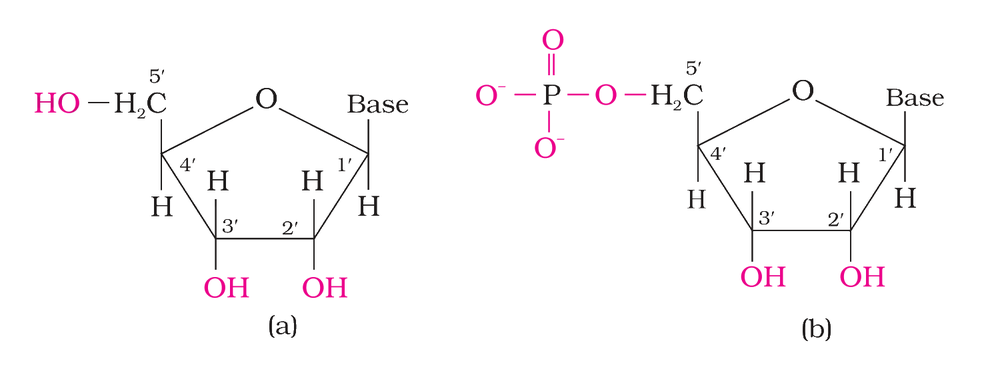
The figure shows two structures, (a) and (b), related to nucleic acids.
Which of the two structures is a nucleotide, and what makes it a nucleotide?
Answer & explanation
Correct answer: option 3
The correct answer is Option (3) → (b); it has a phosphate group attached at the 5′ carbon of the sugar
A nucleoside is a base attached to the 1′ position of the sugar. When a nucleoside is linked to phosphoric acid at the 5′ position of the sugar, a nucleotide is formed.
Comparing (a) and (b) — both have the base at 1′ and –OH groups at 2′ and 3′. They differ only at the 5′ carbon, the CH2 outside the ring: (a) has HO–H2C–, while (b) has a phosphate group joined through oxygen.
So (b) is the nucleotide and (a) is the nucleoside.
Why the other options are incorrect
Option (1) (a); it has a base attached at the 1′ carbon of the sugar — Incorrect. A base at the 1′ carbon makes (a) a nucleoside; (a) has no phosphate group, so it is not a nucleotide.
Option (2) (a); it has a free –OH group at the 5′ carbon of the sugar — Incorrect. The free –OH at 5′ shows that no phosphoric acid is linked there, so (a) is the nucleoside.
Option (4) (b); it has free –OH groups at the 2′ and 3′ carbons of the sugar — Incorrect. (b) is the nucleotide, but (a) has the same –OH groups at 2′ and 3′; it is the phosphate group at 5′ that makes (b) a nucleotide.
NCERT (2026-27 edition):
10.5.2 Structure of Nucleic Acids – “A unit formed by the attachment of a base to 1′ position of sugar is known as nucleoside. In nucleosides, the sugar carbons are numbered as 1′, 2′, 3′, etc. in order to distinguish these from the bases (Fig. 10.5a). When nucleoside is linked to phosphoric acid at 5′-position of sugar moiety, we get a nucleotide (Fig. 10.5).”
Fig. 10.5: Structure of (a) a nucleoside and (b) a nucleotide