Which of the following statements is true?
Answer & explanation
Correct answer: option 3
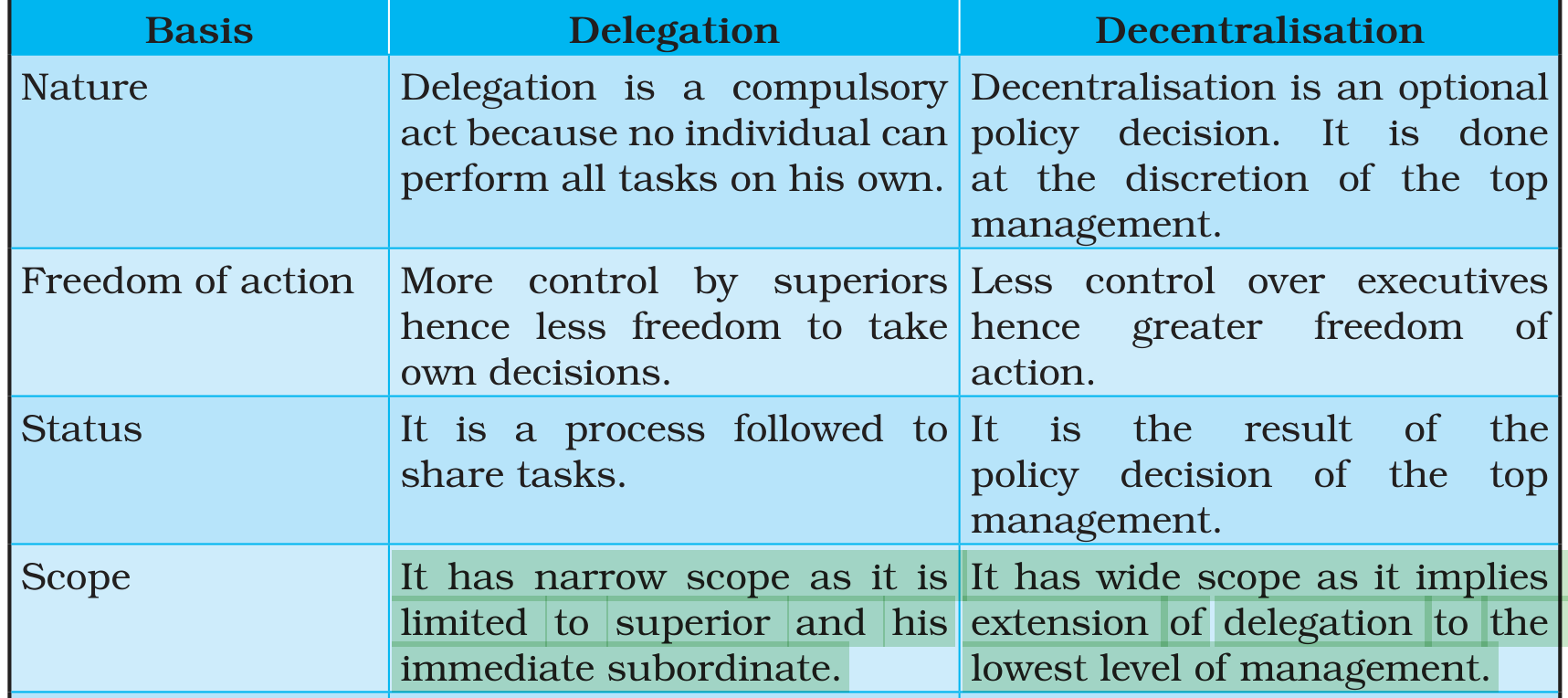
The correct answer is Option (3) → Delegation is individual and Decentralisation is totalistic in nature.
Option (1) Delegation is optional, whereas Decentralization is essential to get things done by others. — Incorrect. It is the other way round. Delegation is compulsory, because no one can do every task alone. Decentralisation is an optional policy decision of top management.
Option (2) In delegation, management exercises minimal control and in decentralization, control rests on supervisor. — Incorrect. This is also reversed. In delegation the superior keeps more control, so the subordinate has less freedom. In decentralisation there is less control over managers and more freedom to act.
Option (3) Delegation is individual and Decentralisation is totalistic in nature. — Correct. The two differ in scope. Delegation has a narrow scope. It is only between a superior and his immediate subordinate. So it is an individual act. Decentralisation has a wide scope. It spreads delegation down to the lowest level of management. So it covers the whole organisation (“totalistic”).
Option (4) Delegation is a step towards the formation of semi-autonomous units whereas Decentralisation creates superior- subordinate relationships. — Incorrect. This is reversed too. Delegation creates superior-subordinate relationships, which form the management hierarchy. Decentralisation spreads decision making through the organisation. It is what leads to semi-autonomous units (units that run themselves to a large extent).
NCERT (2026-27 Edition):
|