
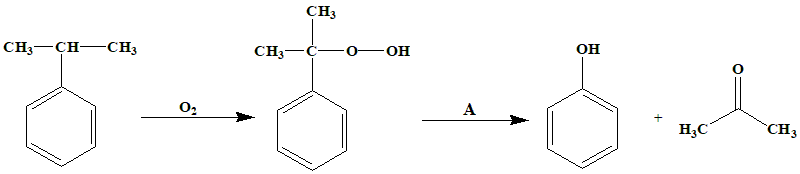
'A' in the following reaction is:
Answer & explanation
Correct answer: option 4
The correct answer is Option (4) → H3O+
This is the industrial cumene process for phenol. First, cumene (isopropylbenzene) is oxidised by air to cumene hydroperoxide:
\( \displaystyle \ce{C6H5CH(CH3)2 + O2} \xrightarrow{\text{air}} \ce{C6H5C(CH3)2-O-OH} \)
Then dilute acid (H3O+) cleaves the hydroperoxide into phenol and acetone:
\( \displaystyle \ce{C6H5C(CH3)2-O-OH} \xrightarrow{\ce{H3O+}} \ce{C6H5OH + CH3COCH3} \)
So reagent A is H3O+.
Why the other options are incorrect
Option (1) NaOH (aq.) — Incorrect. The cleavage of cumene hydroperoxide to phenol and acetone is acid-catalysed; aqueous alkali does not bring it about.
Option (2) NaOH (alc.) — Incorrect. Alcoholic alkali is used for elimination from alkyl halides; it does not convert the hydroperoxide into phenol.
Option (3) KMnO4 (alk.) — Incorrect. An oxidising agent; with the alkyl side chain it would give benzoic acid, not phenol and acetone.
NCERT (2026-27 edition):
From Cumene – “Phenol is manufactured from the hydrocarbon, cumene. Cumene (isopropylbenzene) is oxidised in the presence of air to cumene hydroperoxide. It is converted to phenol and acetone by treating it with dilute acid. Acetone, a by-product of this reaction, is also obtained in large quantities by this method.”