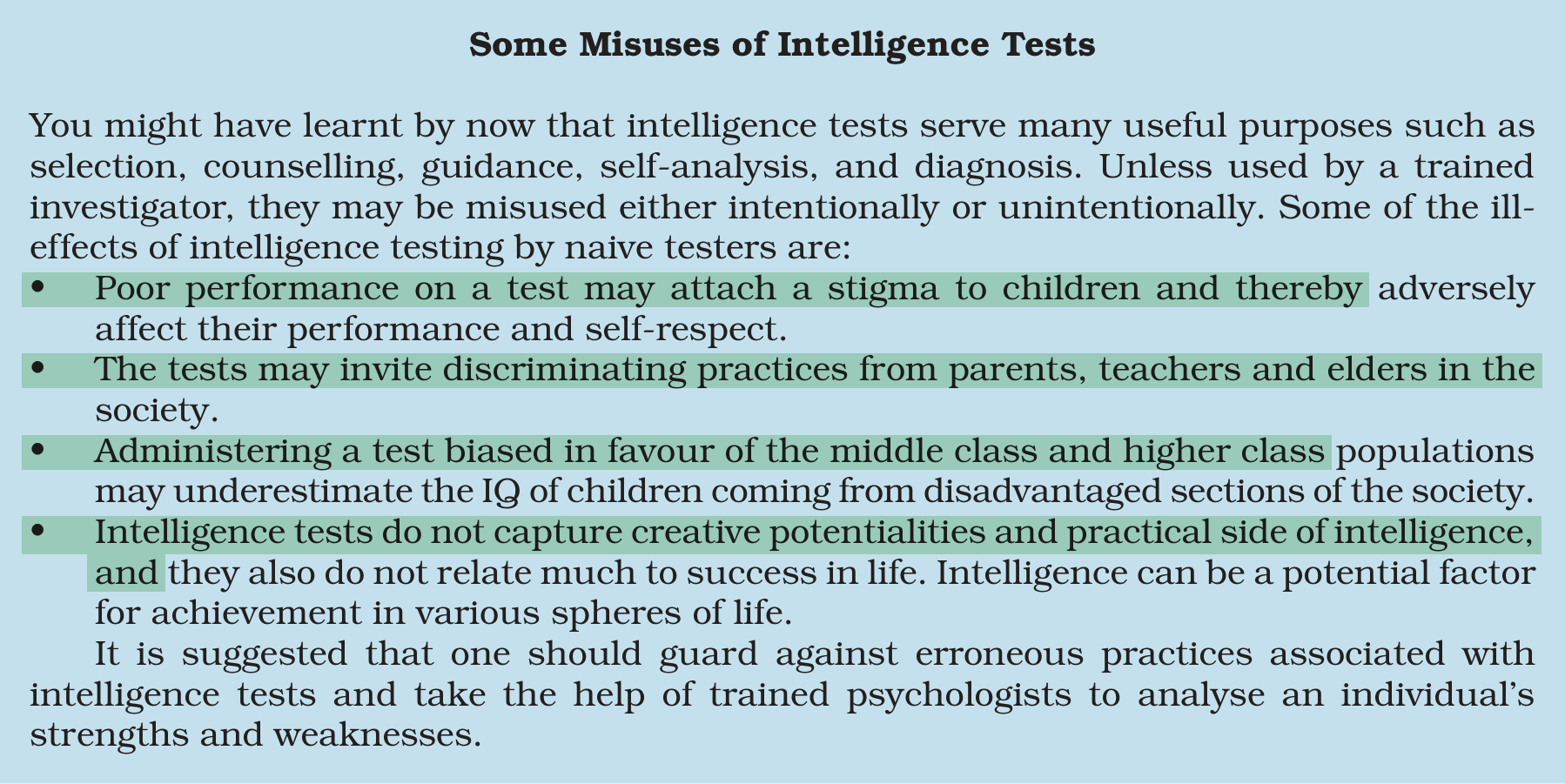
Match List-I with List-II.
| List-I | List-II |
|---|---|
| (A) Ravi is called 'dull' after one low score and doubts himself | (I) A biased test underestimates disadvantaged children's IQ |
| (B) Parents favour their high-scoring son over his low-scoring daughter | (II) Stigma adversely affects performance and self-respect |
| (C) A village child scores low on an urban middle class test | (III) Tests do not relate much to success in life |
| (D) A boy with an ordinary score later builds a successful business | (IV) Tests invite discriminating practices from parents and elders |
Choose the correct answer from the options given below:
Answer & explanation
Correct answer: option 2
The correct answer is Option (2) → A-II, B-IV, C-I, D-III
| List-I | List-II | Reason |
|---|---|---|
| (A) Ravi is called 'dull' after one low score and doubts himself | (II) Stigma adversely affects performance and self-respect | Calling Ravi 'dull' after one low score attaches a stigma to him. That stigma lowers his self-respect and can pull down his later performance. |
| (B) Parents favour their high-scoring son over his low-scoring daughter | (IV) Tests invite discriminating practices from parents and elders | The parents treat their children unequally because of test scores. This is the discriminating practice by parents and elders that tests can invite. |
| (C) A village child scores low on an urban middle class test | (I) A biased test underestimates disadvantaged children's IQ | A test built on urban, middle class experiences is biased against the village child, so it may underestimate the IQ of children from disadvantaged sections. |
| (D) A boy with an ordinary score later builds a successful business | (III) Tests do not relate much to success in life | The boy's ordinary score did not predict his success in business. Tests miss creative and practical sides of intelligence, so they do not relate much to success in life. |
NCERT (2026-27):
|