"First of all I would look at it as not rupee sliding, I would look at it as dollar strengthening, dollar strengthening incessantly," said Nirmala Sitharaman after attending the Annual meetings of the IMF and the World Bank.
Based on the above passage, answer the questions mentioned below :
What is the other name for flexible exchange rate system ?
Answer & explanation
Correct answer: option 2
The correct answer is Option (2) → Floating exchange rate system
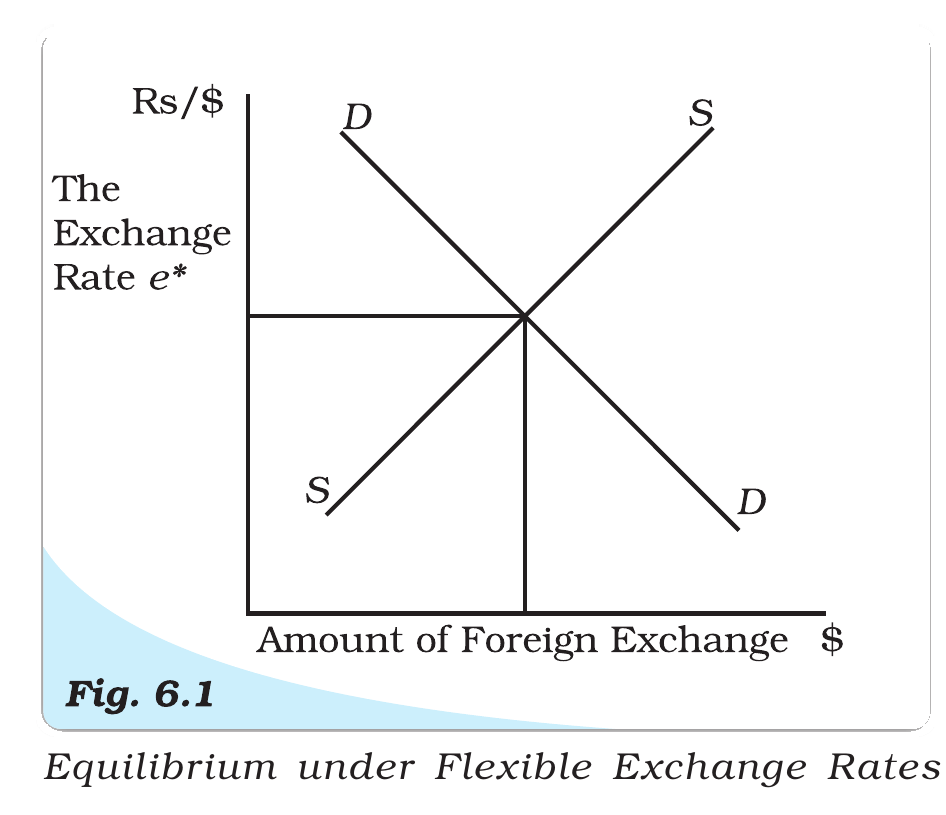
A flexible exchange rate is set by the market forces of demand and supply. It is also known as the floating exchange rate.
Option (1) Dirty floating exchange rate system — Incorrect. This is another name for managed floating. Central banks buy and sell foreign currencies to limit the movements of the rate.
Option (2) Floating exchange rate system — Correct. The rate moves with demand and supply. In a completely flexible system, central banks do not intervene.
Option (3) Pegged exchange rate system — Incorrect. Here the government ties the rate to a particular level. This is a fixed exchange rate.
Option (4) Managed floating exchange rate system — Incorrect. This is a mixture of the flexible and fixed systems. The market moves the rate, and central banks step in when they feel the need.
NCERT (2026-27): “Flexible Exchange Rate This exchange rate is determined by the market forces of demand and supply. It is also known as Floating Exchange Rate. As depicted in Fig. 6.1, the exchange rate is determined where the demand curve intersects with the supply curve, i.e., at point e on the Y – axis. Point q on the x – axis determines the quantity of US Dollars that have been demanded and supplied on e exchange rate. In a completely flexible system, the Central banks do not intervene in the foreign exchange market.… Fixed Exchange Rates In this exchange rate system, the Government fixes the exchange rate at a particular level.… Thus, through intervention, the Government can maintain any exchange rate in the economy.… 6.2.4 Managed Floating Without any formal international agreement, the world has moved on to what can be best described as a managed floating exchange rate system. It is a mixture of a flexible exchange rate system (the float part) and a fixed rate system (the managed part). Under this system, also called dirty floating, central banks intervene to buy and sell foreign currencies in an attempt to moderate exchange rate movements whenever they feel that such actions are appropriate.…”
|