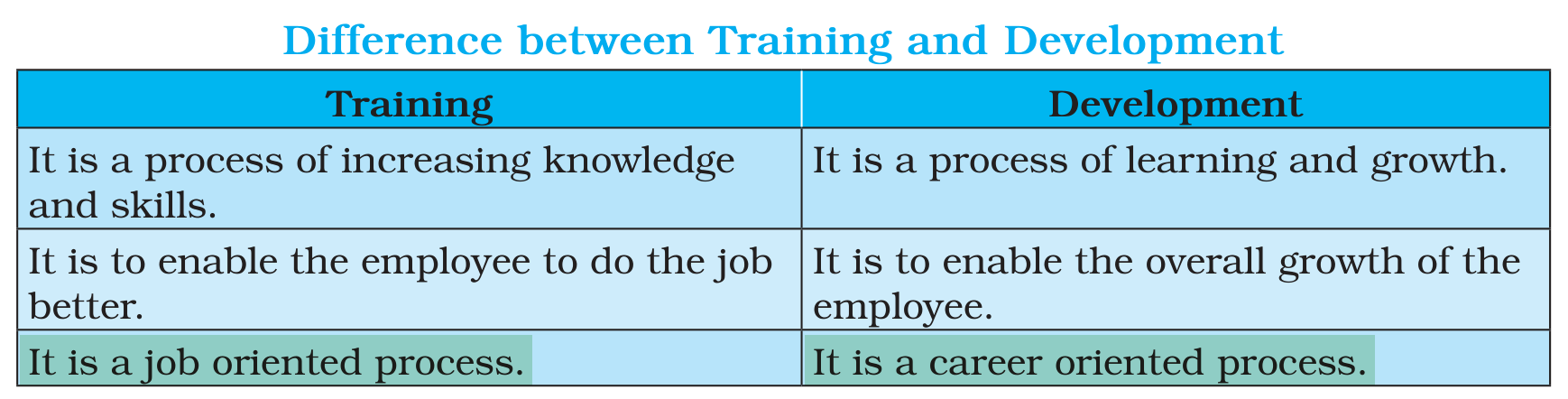
Match List-I (terms) with List-II (their features):
| List-I | List-II | ||
|---|---|---|---|
| (A) | Training | (I) | It develops a logical and rational mind that can understand a phenomenon. |
| (B) | Development | (II) | It is a job oriented process. |
| (C) | Education | (III) | It familiarises the selected employee with the rules and policies of the organisation. |
| (D) | Orientation | (IV) | It is a career oriented process. |
Choose the correct answer from the options given below:
Answer & explanation
Correct answer: option 1
The correct answer is Option (1) → (A)-(II), (B)-(IV), (C)-(I), (D)-(III)
| List-I | List-II | Reason |
|---|---|---|
| (A) Training | (II) It is a job oriented process. | Training builds skills for a specific job. |
| (B) Development | (IV) It is a career oriented process. | Development helps the person grow through the whole career. |
| (C) Education | (I) It develops a logical and rational mind that can understand a phenomenon. | Education gives no ready answers. It trains the mind to see relationships among variables. |
| (D) Orientation | (III) It familiarises the selected employee with the rules and policies of the organisation. | Orientation is done when a person joins. It introduces him to colleagues, rules and policies. |
NCERT (2026-27 Edition): “(iv) Placement and Orientation: Joining a job marks the beginning of socialisation of the employee at the workplace. The employee is given a brief presentation about the company and is introduced to his superiors, subordinates and the colleagues. He is taken around the workplace and given the charge of the job for which he has been selected. This process of familiarisation is very crucial and may have a lasting impact on his decision to stay and on his job performance. Orientation is, thus, introducing the selected employee to other employees and familiarising him with the rules and policies of the organisation. …” “Training, Development and Education … Education is the process of increasing the knowledge and understanding of employees. It is the understanding and interpretation of knowledge. It does not provide definite answers, but rather develops a logical and rational mind that can determine relationships among pertinent variables and thereby understand a phenomenon. …”
|