
The variation of electric field with respect to distance from centre of a charged conducting spherical shell of radius R is given by :
Answer & explanation
Correct answer: option 2
The correct answer is Option (2)
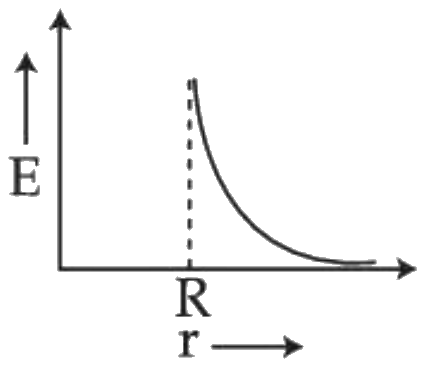
Apply Gauss's law to a spherical Gaussian surface of radius \( r \) concentric with the shell of charge \( q \).
Inside (\( r \lt R \)): the Gaussian surface encloses no charge, so
\( \displaystyle E = 0 \)
Outside (\( r \gt R \)): the whole charge is enclosed, so
\( \displaystyle E = \frac{1}{4\pi\varepsilon_0}\,\frac{q}{r^{2}} \)
So the field is zero inside, jumps to its largest value at \( r = R \), and then falls as \( 1/r^{2} \). Graph (2) shows exactly this.
Why the other options are incorrect
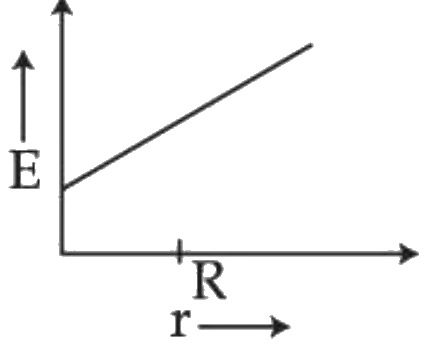
Option (1) — Incorrect. The field here is non-zero inside the shell and keeps rising with \( r \); inside a charged shell the field is zero, and outside it decreases.
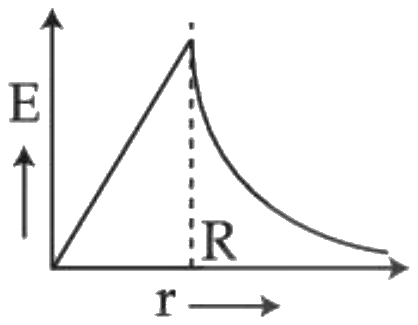
Option (3) — Incorrect. A field rising linearly inside and falling as \( 1/r^{2} \) outside belongs to a uniformly charged solid (non-conducting) sphere, not a shell.
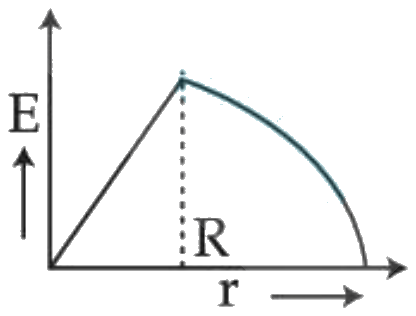
Option (4) — Incorrect. The field is not zero inside, and outside it drops to zero at a finite distance; the actual field outside falls gradually as \( 1/r^{2} \).
Note: A similar question was also asked in CUET (UG) 2023 on 12-06-2023 (Slot 2) and on 10-06-2023 (Slot 1), and in CUET (UG) 2022 on 23-08-2022 (Slot 1).
NCERT (2026-27):
Summary – “… (iii) Thin spherical shell of uniform surface charge density σ
\( \displaystyle \mathbf{E} = \frac{q}{4\pi\varepsilon_0 r^2}\,\hat{\mathbf{r}} \quad (r \ge R), \qquad \mathbf{E} = 0 \quad (r \lt R) \)
… The electric field outside the shell is as though the total charge is concentrated at the centre. … The field is zero at all points inside the shell.”