
Which of the following reaction is shown by aldehydes that do not have alpha H-atom?
Answer & explanation
Correct answer: option 3
The correct answer is Option (3) → Cannizzaro reaction
Aldehydes without alpha hydrogen cannot undergo aldol reaction.
Instead, they undergo Cannizzaro reaction.
The Cannizzaro reaction is a chemical process specific to aldehydes that lack an alpha-hydrogen atom. In this reaction, the aldehyde undergoes self-oxidation and reduction (disproportionation) when treated with a concentrated alkali. One molecule of the aldehyde is reduced to a primary alcohol, while another is oxidized to the salt of a carboxylic acid. Common examples of aldehydes that undergo this reaction include formaldehyde ($\text{HCHO}$) and benzaldehyde ($\text{C}_6\text{H}_5\text{CHO}$).
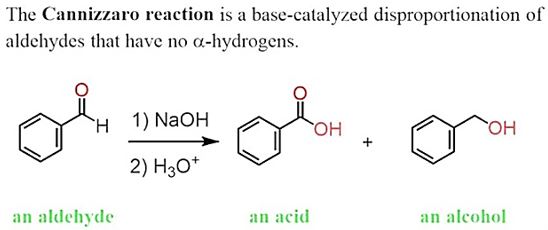
Other options are incorrect:
Aldol condensation → requires alpha hydrogen atoms.
Cross aldol condensation → also requires alpha hydrogen atoms.
Kolbe's reaction → related to phenols or electrolysis of carboxylates, not aldehydes.
Therefore, the correct answer is Cannizzaro reaction.