
The scheme shows the reaction of anisole with ethanoyl chloride in the presence of anhydrous aluminium chloride.
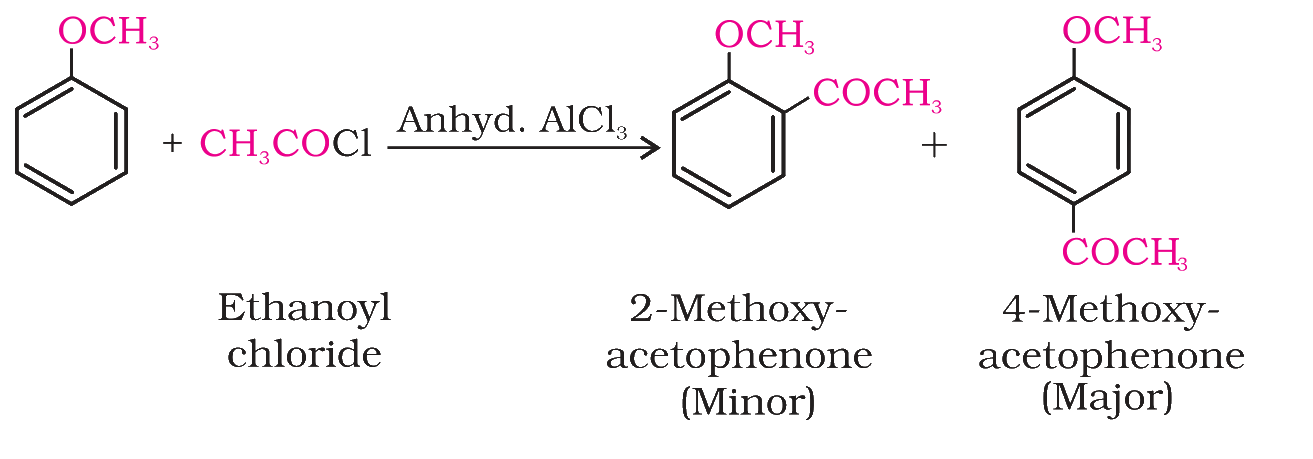
Which of the following correctly describes the –OCH3 group of anisole in this reaction?
Answer & explanation
Correct answer: option 4
The correct answer is Option (4) → It directs the acetyl group to the ortho and para positions, and it activates the ring towards electrophilic substitution.
The scheme is a Friedel-Crafts acylation, an electrophilic substitution in which the acetyl group (CH3CO–) of ethanoyl chloride replaces a hydrogen atom of the ring, with anhydrous AlCl3 as the catalyst.
Position of the new group — ortho and para. The two products carry –COCH3 at position 2 (2-methoxyacetophenone) and at position 4 (4-methoxyacetophenone), that is, ortho and para to –OCH3; neither has it at position 3.
\( \displaystyle \ce{C6H5OCH3 + CH3COCl} \xrightarrow{\text{anhyd. }\ce{AlCl3}} \ce{CH3OC6H4COCH3 + HCl} \)
Effect on the ring — activates it. Like the –OH group of phenol, the –OCH3 group makes the ortho and para positions electron rich by its resonance effect, so the ring reacts more readily with electrophiles.
Why the other options are incorrect
Option (1) It directs the acetyl group to the meta position, and it deactivates the ring towards electrophilic substitution. — Incorrect. Neither product has the acetyl group at position 3, and the –OCH3 group makes the ring more reactive, not less.
Option (2) It directs the acetyl group to the ortho and para positions, and it deactivates the ring towards electrophilic substitution. — Incorrect. The positions are right, but the resonance effect of –OCH3 makes the ring electron rich, so the ring is activated, not deactivated.
Option (3) It directs the acetyl group to the meta position, and it activates the ring towards electrophilic substitution. — Incorrect. The ring is activated, but the products show the acetyl group at positions 2 and 4, not at position 3.
NCERT (2026-27 edition):
7.6.3 Chemical Reactions – “The alkoxy group (-OR) is ortho, para directing and activates the aromatic ring towards electrophilic substitution in the same way as in phenol.”
“(ii) Friedel-Crafts reaction: Anisole undergoes Friedel-Crafts reaction, i.e., the alkyl and acyl groups are introduced at ortho and para positions by reaction with alkyl halide and acyl halide in the presence of anhydrous aluminium chloride (a Lewis acid) as catalyst.”
7.4.4 Chemical Reactions – “The –OH group attached to the benzene ring activates it towards electrophilic substitution. Also, it directs the incoming group to ortho and para positions in the ring as these positions become electron rich due to the resonance effect caused by –OH group.”
Friedel-Crafts acylation of anisole (7.6.3)