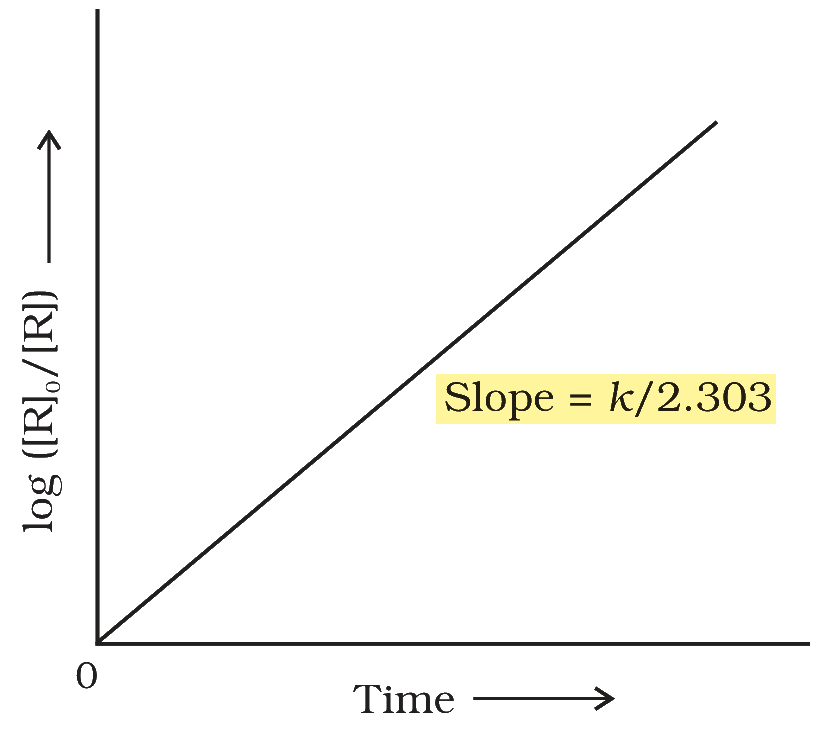
In the plot of \( \log\frac{[R]_0}{[R]} \) versus time for a first order reaction (where [R] represents the concentration of the reactant), the slope and intercept are respectively equal to ______
Answer & explanation
Correct answer: option 3
The correct answer is Option (3) → k/2.303 and zero
For a first order reaction R → P, the rate is proportional to the concentration of R. Integrating the rate law gives the integrated rate equation:
\( \displaystyle -\frac{d[\mathrm{R}]}{dt} = k[\mathrm{R}] \)
\( \displaystyle \ln\frac{[\mathrm{R}]_0}{[\mathrm{R}]} = kt \)
Changing to common logarithms (\( \ln x = 2.303 \log x \)):
\( \displaystyle \log\frac{[\mathrm{R}]_0}{[\mathrm{R}]} = \frac{k}{2.303}\,t \)
This has the form y = mx, a straight line through the origin. Plotting \( \log([\mathrm{R}]_0/[\mathrm{R}]) \) against t therefore gives:
slope \( = \frac{k}{2.303} \)
intercept = 0, since at t = 0, \( [\mathrm{R}] = [\mathrm{R}]_0 \) and \( \log 1 = 0 \).
So the slope and intercept are k/2.303 and zero.
Why the other options are incorrect
Option (1) k and zero — Incorrect. A slope of k belongs to the plot of \( \ln([\mathrm{R}]_0/[\mathrm{R}]) \), with natural logarithms; with \( \log \) the slope is divided by 2.303.
Option (2) k and one — Incorrect. The line passes through the origin, because \( \log 1 = 0 \), not 1; the slope is also not k.
Option (4) 2.303k and zero — Incorrect. The factor 2.303 has been multiplied instead of divided.
NCERT (2026-27 edition):
First Order Reactions – “… The first order rate equation (3.10) can also be written in the form”
\( \displaystyle k = \frac{2.303}{t}\log\frac{[\mathrm{R}]_0}{[\mathrm{R}]} \)
“… If we plot a graph between log [R]0/[R] vs t, (Fig. 3.5), the slope = k/2.303”