
CUETMOCK
  • Pricing
  • Mentors
Log inStart freeStart free mocks→

First test, then trust

Try a free CUET mock test.

Join 5,00,000+ students who rehearsed exam day on the exact NTA screen before sitting CUET. On the web and on Android.

Start free mocks →Get the Android app
CUETMOCK

India's #1 CUET Mock Test Platform. Original NCERT-based questions on the exact NTA exam screen — trusted by 5,00,000+ students since CUET 2022.

Get it onGoogle PlayScan to download the CUETMOCK app

Mock tests

  • CUET mock test series
  • Browse all papers
  • Commerce mocks
  • Humanities (Arts) mocks
  • Science mocks
  • Languages & GAT mocks
  • Free practice questions
  • Pricing

Resources

  • CUET exam guide
  • CUET syllabus
  • Universities accepting CUET
  • Expert blogs
  • News & notifications
  • Webinars & counselling
  • CUET score calculator
  • How we estimate your rank
  • FAQs

Company

  • About us
  • Our leadership & team
  • Our toppers
  • Mentors
  • For schools
  • Contact us
  • Terms
  • Privacy
  • Refund policy

Talk to us

+91 7696 6630 56info@cuetmock.comWhatsApp us

Our other platforms

  • JEE Mock — For IIT-JEE aspirants
  • NEET Mock — For NEET aspirants

Newsletter

Exam updates, study material and offers — no spam.

© 2026 NYC Ventures Pvt. Ltd.

701-702, Royal Business Park, Zirakpur, Punjab - 140603

  • Terms of use
  • Privacy policy
  • Refund policy
  • Contact us

iCUETMOCK is an independent preparation platform, not affiliated with the National Testing Agency (NTA). Always check exam details on the official NTA website.

  • Home
  • Mock tests
  • CUET guide
  • Pricing
  • Log in
Home/Practice questions/Chemistry
ChemistryOrganic: Aldehydes, Ketones and Carboxylic Acids

The product (A) is:

Answer the question on basis of passage given below:

Organic compounds containing carbon-oxygen double bonds (C=O) are called carbonyl compounds. These are highly polar molecules. Hence, their boiling points are higher than hydrocarbons and ethers. Aldehydes can be prepared from dehydrogenation or oxidation of alcohols and by reduction of acyl halides. Ketones are prepared by oxidation of secondary alcohols or by hydration of alkynes etc. Aldehydes and ketones undergo nucleophilic addition reaction with a number of nucleophiles such as HCN, NaHSO3, ammonia derivatives. Carboxylic acids are prepared by the oxidation of primary alcohols, aldehydes and alkenes, by hydrolysis of nitriles. Carboxylic acids are more acidic than alcohols and phenols.

The product (A) is:
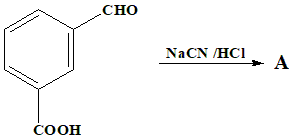
Figure for Q10

Answer & explanation+

Correct answer: option 2

The correct answer is Option (2) → 3-[CH(OH)CN]C6H4COOH (cyanohydrin at the former CHO group)

NaCN with HCl generates HCN, and the cyanide ion adds to the carbonyl carbon of an aldehyde (nucleophilic addition) to give a cyanohydrin, >C(OH)CN. The carbonyl of a –COOH group does not undergo this addition: its C=O is stabilised by resonance with the –OH oxygen and is far less electrophilic.

So in 3-formylbenzoic acid only the –CHO group reacts and the –COOH group is unchanged:

    3-\( \ce{OHC-C6H4-COOH} \) + HCN → 3-\( \ce{[NC-CH(OH)]-C6H4-COOH} \)

This is the structure in Option (2).

Why the other options are incorrect

  • Option (1) — Incorrect. Benzene-1,3-dicarboxylic acid would need the CHO group to be oxidised; NaCN/HCl is not an oxidising agent.

  • Option (3) — Incorrect. A \( \ce{CH2OH} \) group is the product of reducing the CHO group (for example with \( \ce{NaBH4} \)), not of adding HCN.

  • Option (4) — Incorrect. It shows the cyanohydrin formed at the carbon of the –COOH group with the CHO group left intact; carboxylic acids do not add HCN, so this cannot form.

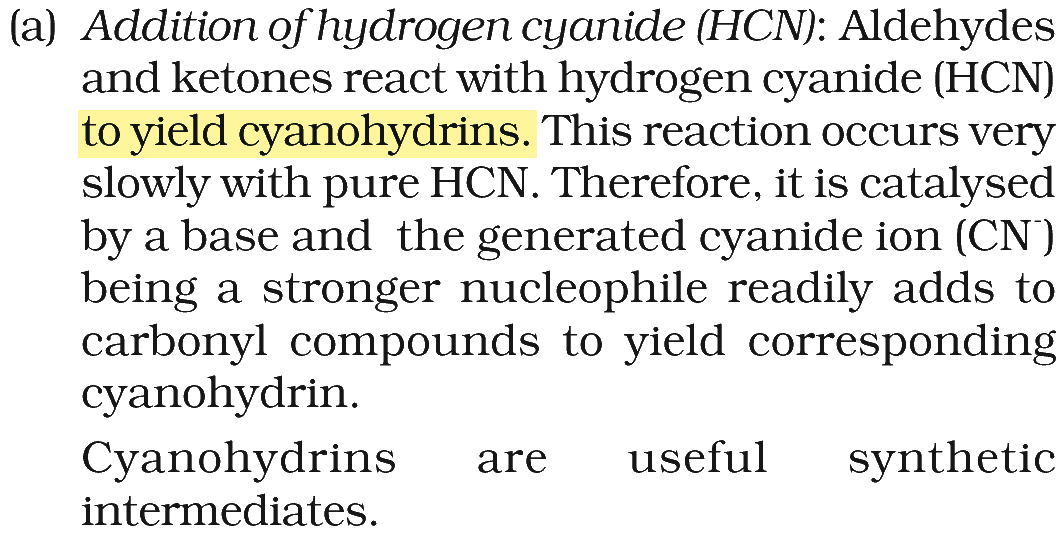
NCERT (2026-27 edition):
Addition of Hydrogen Cyanide (HCN)
Textbook extract

Advertisement

Practise more on Organic: Aldehydes, Ketones and Carboxylic Acids

Chapter-wise mocks on the real NTA exam screen, with solutions and your rank. Your first mocks are free.

Start free mocks →

Advertisement

Next questions

  1. Physics · Communication
  2. Sentences of a paragraph are given below in jumbled order. Arrange the sentences in the correct order to form a meaningful and coherent par…English · Arrange in Meaningful Sequence
  3. Which of the following functions are strictly decreasing on ≤ft(0,(π)/2) ?Maths. Section B1 · Applications of Derivatives
  4. Which of the following is true?Physics · Nuclei
  5. Consider the following statements regarding debates within communities during the period of social reform: Statement 1: Jahanara Shah Nawas…Sociology · Social Change and Development in India: Cultural Change
  6. Which of the following is not included in semantic barriers to communication? (A) Unclarified assumptions (B) Distrust (C) Poor retention (…Business Studies · Directing
  7. Given below are two statements:Statement I: For products requiring long-term storage, such as agricultural products, warehouses are located…Business Studies · Marketing
  8. During DNA replication, in which direction is the new DNA strand polymerised?Biology · Molecular Basis of Inheritance
  9. "Those who score high on this factor are imaginative, curious, and interested in cultural pursuits."Identify the factor of personality desc…Psychology · Self and Personality
  10. What did the sculptor preserve in casting in bronze the servant girl in 2500 B.C. Harappa?English · Comprehension - (Poetry / Literary)