
CUETMOCK
  • Pricing
  • Mentors
Log inStart freeStart free mocks→

First test, then trust

Try a free CUET mock test.

Join 5,00,000+ students who rehearsed exam day on the exact NTA screen before sitting CUET. On the web and on Android.

Start free mocks →Get the Android app
CUETMOCK

India's #1 CUET Mock Test Platform. Original NCERT-based questions on the exact NTA exam screen — trusted by 5,00,000+ students since CUET 2022.

Get it onGoogle PlayScan to download the CUETMOCK app

Mock tests

  • CUET mock test series
  • Browse all papers
  • Commerce mocks
  • Humanities (Arts) mocks
  • Science mocks
  • Languages & GAT mocks
  • Free practice questions
  • Pricing

Resources

  • CUET exam guide
  • CUET syllabus
  • Universities accepting CUET
  • Expert blogs
  • News & notifications
  • Webinars & counselling
  • CUET score calculator
  • How we estimate your rank
  • FAQs

Company

  • About us
  • Our leadership & team
  • Our toppers
  • Mentors
  • For schools
  • Contact us
  • Terms
  • Privacy
  • Refund policy

Talk to us

+91 7696 6630 56info@cuetmock.comWhatsApp us

Our other platforms

  • JEE Mock — For IIT-JEE aspirants
  • NEET Mock — For NEET aspirants

Newsletter

Exam updates, study material and offers — no spam.

© 2026 NYC Ventures Pvt. Ltd.

701-702, Royal Business Park, Zirakpur, Punjab - 140603

  • Terms of use
  • Privacy policy
  • Refund policy
  • Contact us

iCUETMOCK is an independent preparation platform, not affiliated with the National Testing Agency (NTA). Always check exam details on the official NTA website.

  • Home
  • Mock tests
  • CUET guide
  • Pricing
  • Log in
Home/Practice questions/Biology
BiologyMolecular Basis of Inheritance

During DNA replication, in which direction is the new DNA strand poly…

Read the given passage and answer the following questions:

The Matthew Meselson and Franklin Stahl experiment was to prove that DNA replicates semiconservatively. It was shown first in Escherichia coli and subsequently in higher organisms, such as plants and human cells. The scheme suggested that the two strands would separate and act as a template for the synthesis of new complementary strands. After the completion of replication, each DNA molecule would have one parental and one newly synthesised strand. This scheme was termed as semiconservative DNA replication. Very similar experiments involving use of radioactive thymidine to detect distribution of newly synthesised DNA in the chromosomes was performed on Vicia faba (faba beans) by Taylor and colleagues in 1958. The experiments proved that the DNA in chromosomes also replicate semiconservatively.

During DNA replication, in which direction is the new DNA strand polymerised?

Answer & explanation+

Correct answer: option 1

The correct answer is Option (1) → 5′→3′ only

Each strand of DNA has a direction, from its 5′ end to its 3′ end. A DNA polymerase adds each new nucleotide to the 3′ end of the growing strand, so it can build only in one direction. At the replication fork the two template strands run in opposite directions. The enzyme keeps its single direction on both, and this is why one new strand is made in pieces.

Option (1) 5′→3′ only — Correct. The polymerase always builds the new strand in the 5′→3′ direction and never the other way.

Option (2) 3′→5′ only — Incorrect. 3′→5′ is the polarity of one template strand, not the direction in which the enzyme builds. Polymerisation itself is never 3′→5′.

Option (3) Both 5′→3′ and 3′→5′ on the same strand — Incorrect. The enzyme works in one direction only. It cannot build both ways on the same strand.

Option (4) 3′→5′ on the continuously synthesised strand and 5′→3′ on the discontinuously synthesised strand — Incorrect. Both new strands are built 5′→3′. Synthesis is continuous on one strand and discontinuous on the other, but the direction does not change.

NCERT Extract:
The Machinery and the Enzymes – “… For long DNA molecules, since the two strands of DNA cannot be separated in its entire length (due to very high energy requirement), the replication occur within a small opening of the DNA helix, referred to as replication fork. The DNA-dependent DNA polymerases catalyse polymerisation only in one direction, that is 5′→3′. This creates some additional complications at the replicating fork. Consequently, on one strand (the template with polarity 3′→5′), the replication is continuous, while on the other (the template with polarity 5′→3′), it is discontinuous. The discontinuously synthesised fragments are later joined by the enzyme DNA ligase (Figure 5.8).”
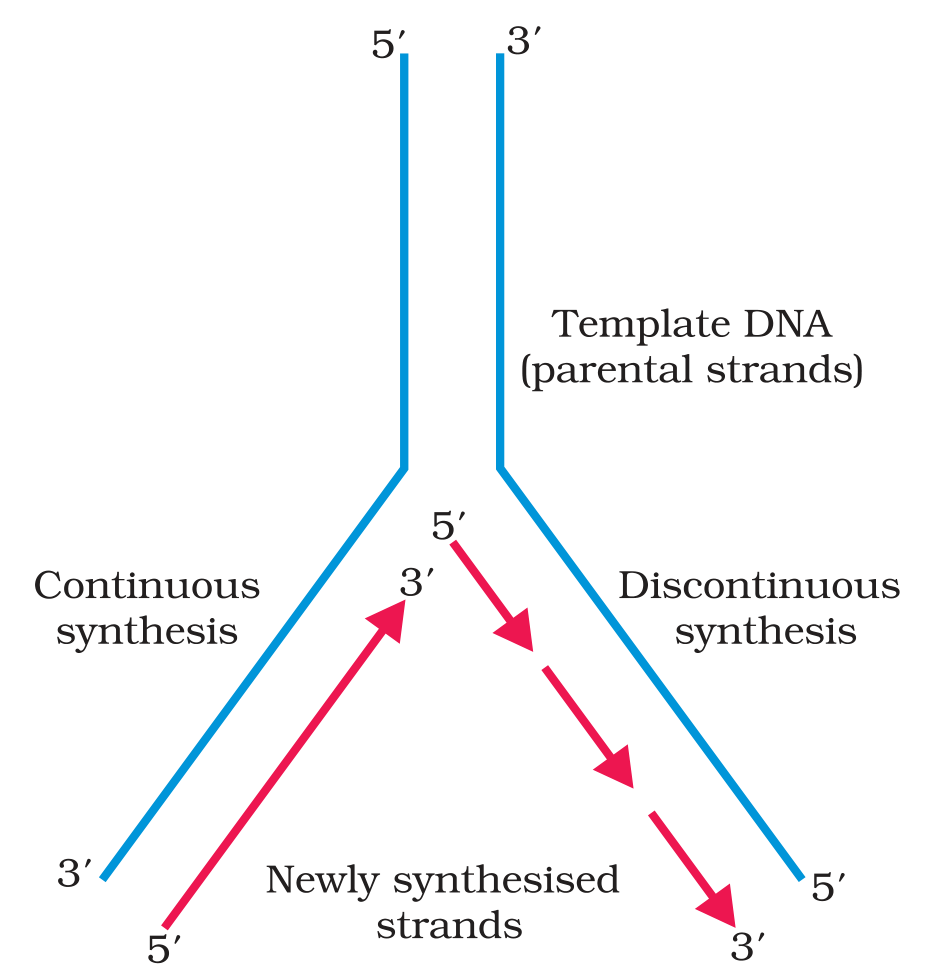
Textbook figure

Figure 5.8 Replicating Fork

Advertisement

Practise more on Molecular Basis of Inheritance

Chapter-wise mocks on the real NTA exam screen, with solutions and your rank. Your first mocks are free.

Start free mocks →

Advertisement

Next questions

  1. "Those who score high on this factor are imaginative, curious, and interested in cultural pursuits."Identify the factor of personality desc…Psychology · Self and Personality
  2. What did the sculptor preserve in casting in bronze the servant girl in 2500 B.C. Harappa?English · Comprehension - (Poetry / Literary)
  3. Who is the implementing agency of "Ayushman Bharat Digital Mission (ABDM)" ?General Aptitude Test · General Knowledge
  4. The value of ∫_0^1sqrt x d xMaths. Section A · Definite Integration
  5. If X^2 +1/(x^2) = 38 , then what is the value of X - 1/x ?General Aptitude Test · Quantitative Reasoning
  6. There is similarity in the properties of second and third transition series. This is because of which of the following?Chemistry · Inorganic: D and F Block Elements
  7. Himanshu is the daughter of Anjan. Mrunalini, Archana’s sister, has a son Rahul and a daughter Sunayana. Kalpika is the mother of Kripal an…General Aptitude Test · Verbal Reasoning
  8. Match List-I (Find at Harappan sites) with List-II (Where it was found).List-IList-II(A) Gold jewellery(I) Distributed throughout settlemen…History · Ancient India: Bricks, Beads and Bones
  9. Which of the following travellers had visited the Vijayanagara Empire in the fifteenth century and written about it?History · Medieval India: An Imperial Capital: Vijayanagara
  10. Mean proportional to 6 and 24 is .General Aptitude Test · Numerical Ability