Which of the following is not correct about the ‘Congress Party’?
Answer & explanation
Correct answer: option 4
The correct answer is Option (4) → The Congress party was a caste-based party.
Option (1) The Congress Party, also known as Indian National Congress was founded in 1885. True. The Congress evolved from its origins in 1885 as a pressure group for the newly educated, professional and commercial classes.
Option (2) The Congress party had inherited the legacy of the national movement. True. At the first general election the Congress had inherited the legacy of the national movement, and it was the only party with an organisation spread all over the country.
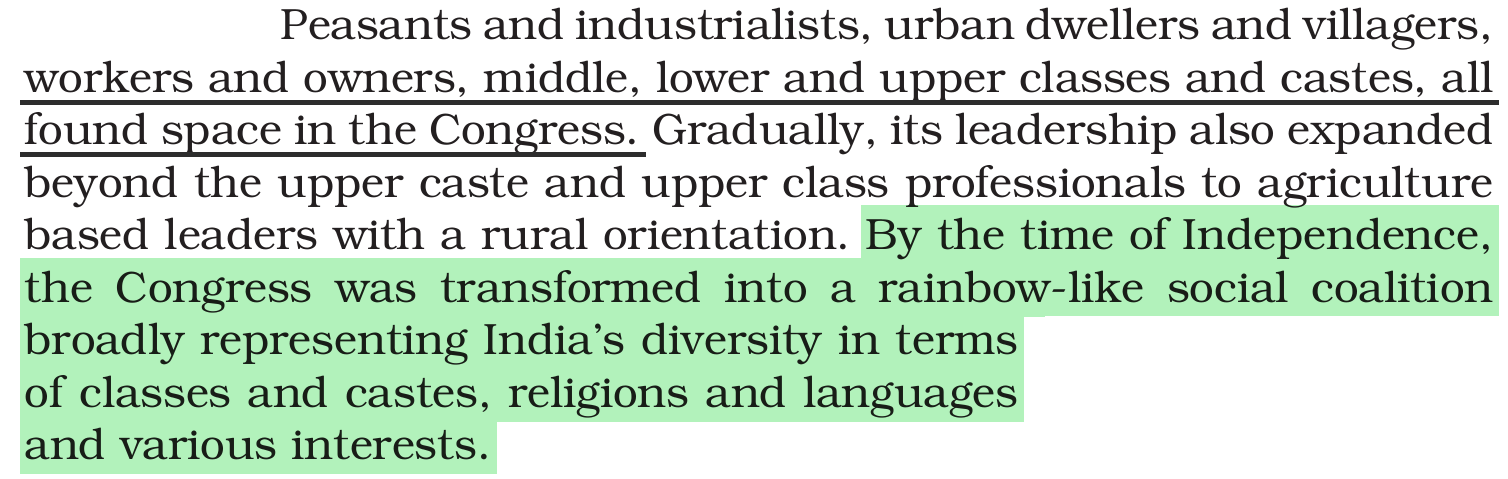
Option (3) The Congress party accommodated each section of society. True. Peasants and industrialists, urban dwellers and villagers, workers and owners, middle, lower and upper classes and castes all found space in the Congress.
Option (4) The Congress party was a caste-based party. False. The Congress began as a party dominated by the upper caste, English-speaking, urban elite, but its social base widened with every movement it launched. By the time of independence it had become a rainbow-like social coalition broadly representing India’s diversity in terms of classes and castes, religions and languages — not a party of one caste.
NCERT (2026-27): “Congress dominance in the first three general elections … The results of the first general election did not surprise anyone. The Indian National Congress was expected to win this election. The Congress party, as it was popularly known, had inherited the legacy of the national movement. It was the only party then to have an organisation spread all over the country. And finally, in Jawaharlal Nehru, the party had the most popular and charismatic leader in Indian politics.… Congress as social and ideological coalition You have already studied the history of how Congress evolved from its origins in 1885 as a pressure group for the newly educated, professional and commercial classes to a mass movement in the twentieth century. This laid the basis for its eventual transformation into a mass political party and its subsequent domination of the political system. Thus the Congress began as a party dominated by the English speaking, upper caste, upper middle-class and urban elite. But with every civil disobedience movement it launched, its social base widened. It brought together diverse groups, whose interests were often contradictory.…”
|