
The figure shows the vapour pressure of solutions of a non-volatile solute plotted against the mole fraction of the solvent, at a fixed temperature.
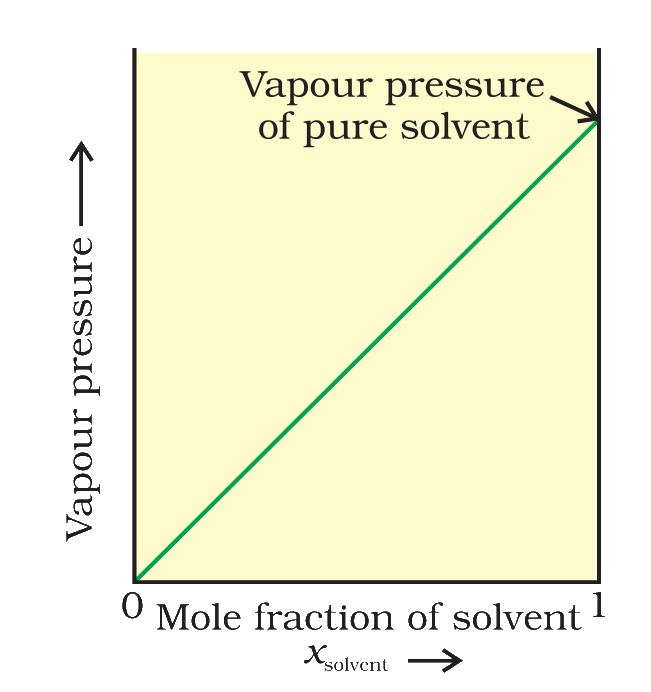
The line starts from zero vapour pressure at the left end of the plot. What does this end of the line stand for?
Answer & explanation
Correct answer: option 3
The correct answer is Option (3) → The pure non-volatile solute, which does not contribute to the vapour pressure
When the solute is non-volatile, only the solvent molecules are present in the vapour phase, so only the solvent contributes to the vapour pressure. By Raoult’s law the vapour pressure is proportional to the mole fraction of the solvent:
\( \displaystyle p_1 = x_1\,p_1^0 \)
Reading the figure — the left end of the line is at xsolvent = 0, where the vapour pressure is zero; the right end is at xsolvent = 1, the vapour pressure of the pure solvent.
The left end — pure non-volatile solute. At x1 = 0 there is no solvent at all, and the solute sends no molecules into the vapour, so p1 = 0 × p10 = 0.
Why the other options are incorrect
Option (1) The pure solvent, all of whose molecules can escape into the vapour — Incorrect. The pure solvent has xsolvent = 1. It is the right end of the line, marked “vapour pressure of pure solvent”, the highest point of the plot.
Option (2) A solution containing equal numbers of moles of solvent and solute — Incorrect. Such a solution has xsolvent = 0.5. It lies in the middle of the line, with a vapour pressure of half that of the pure solvent, not zero.
Option (4) A very dilute solution, whose vapour pressure is not lowered at all — Incorrect. A very dilute solution is almost all solvent, so it lies near xsolvent = 1, at the high end of the line. Any solute lowers the vapour pressure a little.
NCERT (2026-27 edition):
1.4.3 Vapour Pressure of Solutions of Solids in Liquids – “…When the solute is non-volatile, only the solvent molecules are present in vapour phase and contribute to vapour pressure. … Then according to Raoult’s law p1 ∝ x1 and p1 = x1 p10 (1.20) The proportionality constant is equal to the vapour pressure of pure solvent, p10. A plot between the vapour pressure and the mole fraction of the solvent is linear (Fig. 1.5).”
Fig. 1.5: If a solution obeys Raoult’s law for all concentrations, its vapour pressure would vary linearly from zero to the vapour pressure of the pure solvent.