
CUETMOCK
  • Pricing
  • Mentors
Log inStart freeStart free mocks→

First test, then trust

Try a free CUET mock test.

Join 5,00,000+ students who rehearsed exam day on the exact NTA screen before sitting CUET. On the web and on Android.

Start free mocks →Get the Android app
CUETMOCK

India's #1 CUET Mock Test Platform. Original NCERT-based questions on the exact NTA exam screen — trusted by 5,00,000+ students since CUET 2022.

Get it onGoogle PlayScan to download the CUETMOCK app

Mock tests

  • CUET mock test series
  • Commerce mocks
  • Humanities (Arts) mocks
  • Science mocks
  • Languages & GAT mocks
  • Free practice questions
  • Pricing

Resources

  • CUET exam guide
  • CUET syllabus
  • Universities accepting CUET
  • Expert blogs
  • News & notifications
  • Webinars & counselling
  • CUET score calculator
  • How we estimate your rank
  • FAQs

Company

  • About us
  • Our leadership & team
  • Our toppers
  • Mentors
  • For schools
  • Contact us
  • Terms
  • Privacy
  • Refund policy

Talk to us

+91 7696 6630 56info@cuetmock.comWhatsApp us

Our other platforms

  • JEE Mock — For IIT-JEE aspirants
  • NEET Mock — For NEET aspirants

Newsletter

Exam updates, study material and offers — no spam.

© 2026 NYC Ventures Pvt. Ltd.

701-702, Royal Business Park, Zirakpur, Punjab - 140603

  • Terms of use
  • Privacy policy
  • Refund policy
  • Contact us

iCUETMOCK is an independent preparation platform, not affiliated with the National Testing Agency (NTA). Always check exam details on the official NTA website.

  • Home
  • Mock tests
  • CUET guide
  • Pricing
  • Log in
Home/Practice questions/Biology
BiologyHuman Reproduction

Which one of the following pairs of ovarian follicle and its feature…

Which one of the following pairs of ovarian follicle and its feature is correctly matched?

Answer & explanation+

Correct answer: option 3

The correct answer is Option (3) → Graafian follicle – Ruptures to release the secondary oocyte (ovum) from the ovary

An ovarian follicle is a primary oocyte together with the cells that surround it. It grows through a fixed series of stages: primary follicle → secondary follicle → tertiary follicle → Graafian follicle. Each stage has its own mark, so a pair is correct only when the feature belongs to that stage.

Option (1) Primary follicle – Primary oocyte surrounded by more layers of granulosa cells and a new theca — Incorrect. More layers of granulosa cells and a new theca mark the secondary follicle. A primary follicle has a primary oocyte with a single layer of granulosa cells and no theca.

Option (2) Secondary follicle – Fluid-filled cavity called antrum — Incorrect. The antrum first appears in the tertiary follicle. The secondary follicle has gained granulosa layers and a theca, but it has no fluid-filled cavity yet.

Option (3) Graafian follicle – Ruptures to release the secondary oocyte (ovum) from the ovary — Correct. The Graafian follicle is the mature follicle formed from the tertiary follicle. The secondary oocyte inside it is covered by the zona pellucida. In the middle of the menstrual cycle, the LH surge makes this follicle rupture and release the ovum; this is ovulation.

Option (4) Tertiary follicle – Primary oocyte surrounded by a layer of granulosa cells — Incorrect. A single layer of granulosa cells round the primary oocyte is the primary follicle. A tertiary follicle has a fluid-filled antrum, and its theca is organised into theca interna and theca externa.

NCERT Extract:
Gametogenesis – “… Each primary oocyte then gets surrounded by a layer of granulosa cells and is called the primary follicle (Figure 2.7). A large number of these follicles degenerate during the phase from birth to puberty. Therefore, at puberty only 60,000-80,000 primary follicles are left in each ovary. The primary follicles get surrounded by more layers of granulosa cells and a new theca and are called secondary follicles. The secondary follicle soon transforms into a tertiary follicle which is characterised by a fluid filled cavity called antrum.”
Gametogenesis – “… The tertiary follicle further changes into the mature follicle or Graafian follicle (Figure 2.7). The secondary oocyte forms a new membrane called zona pellucida surrounding it. The Graafian follicle now ruptures to release the secondary oocyte (ovum) from the ovary by the process called ovulation.”
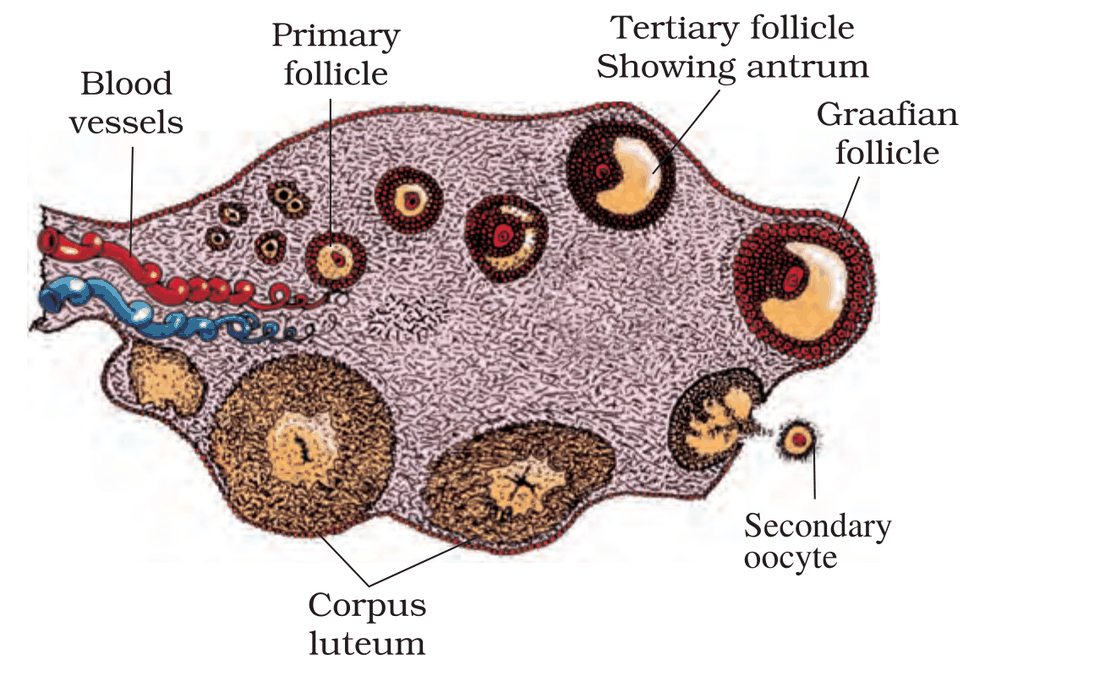
Textbook figure

Figure 2.7 Diagrammatic Section view of ovary

Advertisement

Practise more on Human Reproduction

Chapter-wise mocks on the real NTA exam screen, with solutions and your rank. Your first mocks are free.

Start free mocks →

Advertisement

Next questions

  1. Which scheme among the following is most beneficial to the customer? i) Successive discounts of 25% and 25% ii) Flat discount of 40% iii) B…General Aptitude Test · Numerical Ability
  2. Choose the option figure that should come next if the series below is continued.General Aptitude Test · Non-Verbal Reasoning
  3. Let g(x)=log f(x), where f(x) is twice differentiable positive function on (0, ∞) such that f(x+1)=x f(x). Then, for N=1,2,3, ....g^prime p…Maths. Section B1 · Continuity and Differentiability
  4. Match List I with List II:LIST ITypes of landsLIST IIPeriod of cultivationA.BanjarI.Annually cultivated and never allowed to lie fallowB.Pa…History · Medieval India: Peasants, Zamindars and the State
  5. Identify 'A' from the following compounds:Chemistry · Organic: Aldehydes, Ketones and Carboxylic Acids
  6. Let the vectors a and b be such that |a|=3 and |b|=(√2)/3 then a× b is a unit vector if the angle between a and b isMaths. Section B1 · Vectors
  7. Let f: R → R be a function defined as f(x) = x^4 . Which one of the following is true?Maths. Section B1 · Relations and Functions
  8. Why is there a need to scan the business environment?Entrepreneurship · Entrepreneurial Opportunity
  9. Equal Justice and free legal aid, a provision in the Constitution of India, is provided under which chapter of our Constitution?Legal Studies · Legal Services
  10. limlimits_x → 0 (1-cos x)/(x≤ft(2^x-1)) is equal toMaths. Section B1 · Continuity and Differentiability