CUETMOCK
  • Pricing
  • Mentors
Log inStart freeStart free mocks→

First test, then trust

Try a free CUET mock test.

Join 5,00,000+ students who rehearsed exam day on the exact NTA screen before sitting CUET. On the web and on Android.

Start free mocks →Get the Android app
CUETMOCK

India's #1 CUET Mock Test Platform. Original NCERT-based questions on the exact NTA exam screen — trusted by 5,00,000+ students since CUET 2022.

Get it onGoogle PlayScan to download the CUETMOCK app

Mock tests

  • CUET mock test series
  • Commerce mocks
  • Humanities (Arts) mocks
  • Science mocks
  • Languages & GAT mocks
  • Free practice questions
  • Pricing

Resources

  • CUET exam guide
  • CUET syllabus
  • Universities accepting CUET
  • Expert blogs
  • News & notifications
  • Webinars & counselling
  • CUET score calculator
  • How we estimate your rank
  • FAQs

Company

  • About us
  • Our leadership & team
  • Our toppers
  • Mentors
  • For schools
  • Contact us
  • Terms
  • Privacy
  • Refund policy

Talk to us

+91 7696 6630 56info@cuetmock.comWhatsApp us

Our other platforms

  • JEE Mock — For IIT-JEE aspirants
  • NEET Mock — For NEET aspirants

Newsletter

Exam updates, study material and offers — no spam.

© 2026 NYC Ventures Pvt. Ltd.

701-702, Royal Business Park, Zirakpur, Punjab - 140603

  • Terms of use
  • Privacy policy
  • Refund policy
  • Contact us

iCUETMOCK is an independent preparation platform, not affiliated with the National Testing Agency (NTA). Always check exam details on the official NTA website.

  • Home
  • Mock tests
  • CUET guide
  • Pricing
  • Log in
Home/Practice questions/Political Science
Political ScienceContemporary World Politics: Security in the Contemporary World

What did the NPT do?

Read the passage and answer the questions:

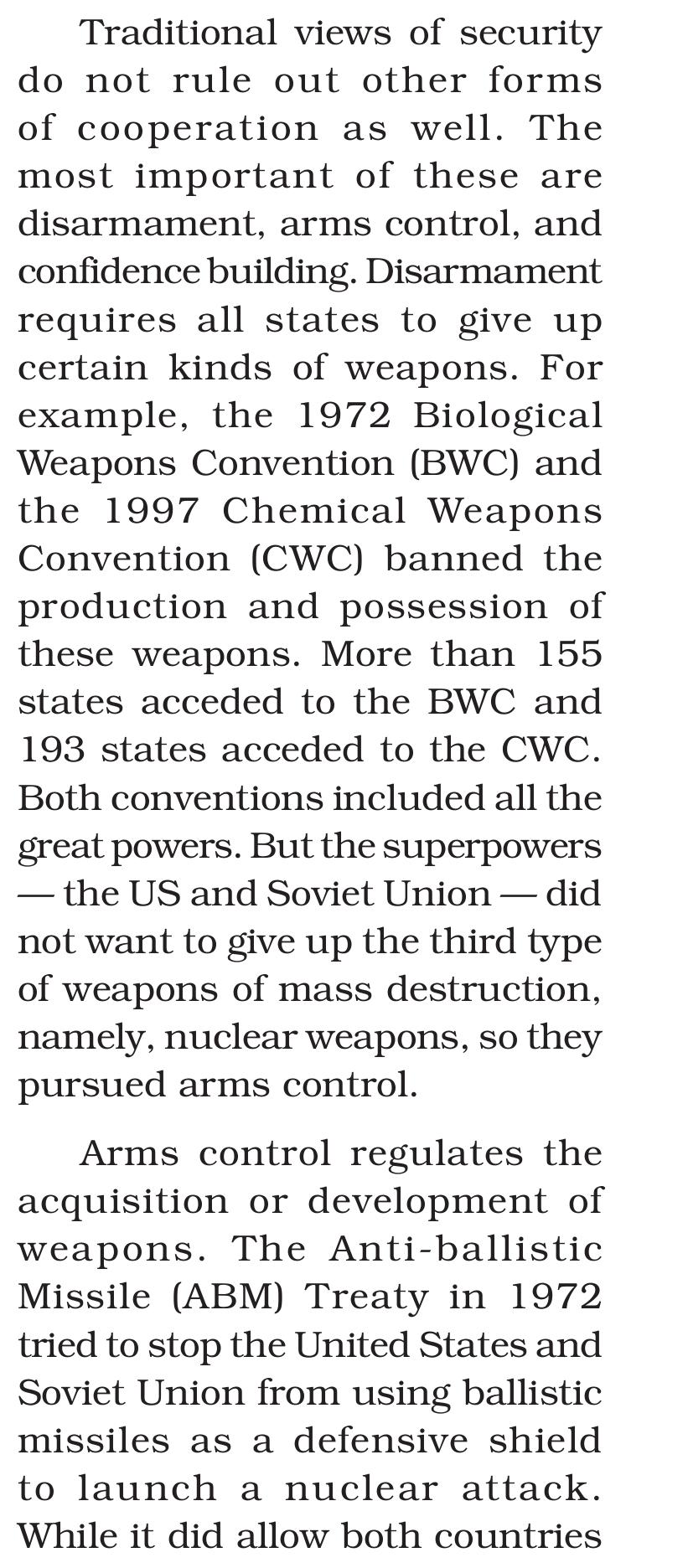
Traditional views of security do not rule out other forms of cooperation as well. The most important of these are disarmament, arms control, and confidence building. The 1972 Biological Weapons Convention (BWC) and the 1997 Chemical Weapons Convention (CWC) banned the production and possession of these weapons. More than 155 states acceded to the BWC and 193 states acceded to the CWC. Both conventions included all the great powers. But the superpowers — the US and Soviet Union — did not want to give up the third type of weapons of mass destruction, namely, nuclear weapons, so they pursued arms control.

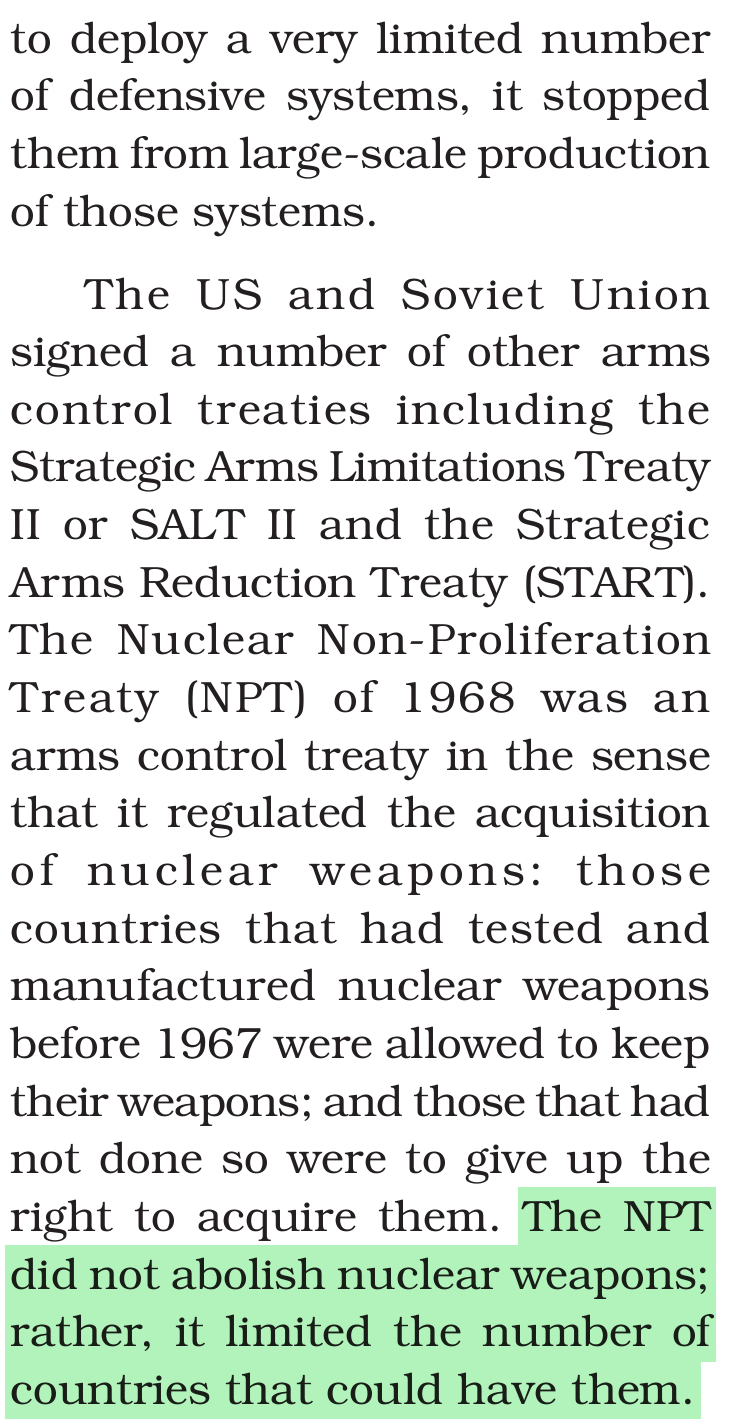
Arms control regulates the acquisition or development of weapons. The Anti-ballistic Missile (ABM) Treaty in 1972 tried to stop the United States and Soviet Union from using ballistic missiles as a defensive shield to launch a nuclear attack. While it did allow both countries to deploy a very limited number of defensive systems, it stopped them from large-scale production of those systems.

The US and Soviet Union signed a number of other arms control treaties including the Strategic Arms Limitations Treaty II or SALT II and the Strategic Arms Reduction Treaty (START). The Nuclear Non-Proliferation Treaty (NPT) of 1968 was an arms control treaty in the sense that it regulated the acquisition of nuclear weapons: those countries that had tested and manufactured nuclear weapons before 1967 were allowed to keep their weapons; and those that had not done so were to give up the right to acquire them. The NPT did not abolish nuclear weapons; rather, it limited the number of countries that could have them.

What did the NPT do?

Answer & explanation+

Correct answer: option 2

The correct answer is Option (2) → It limited the number of countries that could possess nuclear weapons

Option (1) It abolished nuclear weapons — Incorrect. The NPT did not abolish nuclear weapons.

Option (2) It limited the number of countries that could possess nuclear weapons — Correct. The NPT limited the number of countries that could have nuclear weapons: countries that had tested and manufactured them before 1967 could keep them, and the others gave up the right to acquire them.

Option (3) It forced the US to engage India to develop a nuclear weapon — Incorrect. The NPT limited the countries that could have nuclear weapons; India considered it discriminatory and refused to sign it, so it could not have pushed India towards a weapon.

Option (4) It led to both horizontal and vertical proliferation of nuclear weapons — Incorrect. Horizontal proliferation means nuclear weapons spreading to more countries; vertical proliferation means the countries that already have them building more. The NPT was meant to limit the number of countries that could have nuclear weapons, so it was aimed against horizontal proliferation, not a cause of it.

Note: The concepts in Option (4), ‘horizontal proliferation’ and ‘vertical proliferation’, are not in NCERT (2025-26); explained here for the benefit of the students.


NCERT: Contemporary World Politics — Chapter 5: Security in the Contemporary World (2025-26)

NCERT extractNCERT extract

Advertisement

Practise more on Contemporary World Politics: Security in the Contemporary World

Chapter-wise mocks on the real NTA exam screen, with solutions and your rank. Your first mocks are free.

Start free mocks →

Advertisement

Next questions

  1. In the right-angled triangle shown in the figure, if AB = 4 cm and AC = 5 cm, then BC = ?General Aptitude Test · Quantitative Reasoning
  2. Spherical symmetric charge system centered at origin. Electric potential φ=Q/(4 π ε_0 R_0) r ≤ R_0 φ=Q/(4 π ε_0 r) r>R_0Physics · Electrostatic Potential and Capacitance
  3. Match the following in accordance with partnership firm- LIST 1 LIST 2 A) Goodwill I) Likely to earn in future B) Excess profit over normal…Accountancy Part A · Admission of a Partner
  4. The real aim behind the destructive act of supplying arms and ammunition to her people was suggestive of Gulab Kaur's:-English · Comprehension - (Narrative / Factual)
  5. The area bounded by the curve y = √x, Y-axis and between the lines y = 0 and y = 3 isMaths. Section B1 · Application of Integrals
  6. गद्यांश के अनुसार महाराज जनक का परमात्मा से क्या सम्बन्ध था?Hindi · Comprehension - (Narrative / Factual)
  7. Arrange the following historical events in the history of life in chronological order?(A) Natural selection(B) Self-replicating molecules(C…Biology · Evolution
  8. ∫(≤ft(x+√x))/(2√x) dx=Maths. Section A · Indefinite Integration (Section A)
  9. Which of the following statement is true?Accountancy Part A · Admission of a Partner
  10. Select the option that is related to the third term in the same way as the second term is related to the first term and the sixth term is r…General Aptitude Test · General Ability