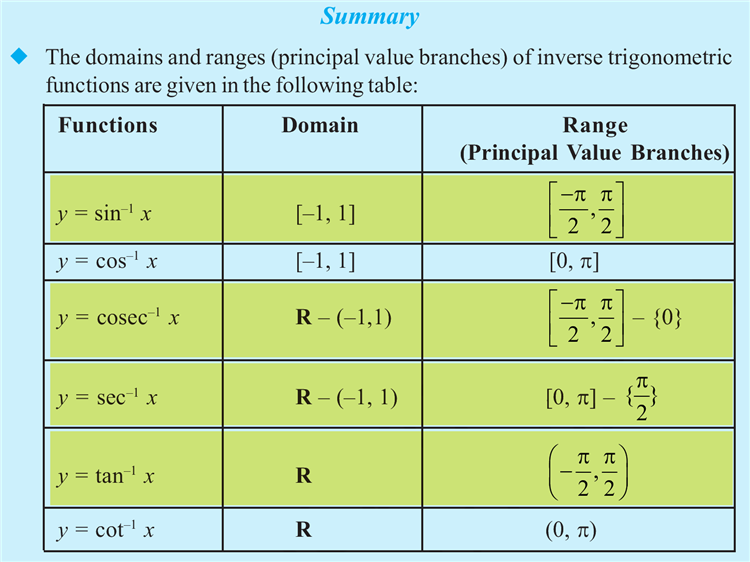
Match List-I with List-II
| List-I | List-II |
| Functions | Range (principal value) |
| (A) \( \sin^{-1}x \) | (I) \( [0,\pi]-\left\{\displaystyle\frac{\pi}{2}\right\} \) |
| (B) \( \tan^{-1}x \) | (II) \( \left[-\displaystyle\frac{\pi}{2},\displaystyle\frac{\pi}{2}\right]-\{0\} \) |
| (C) \( cosec^{-1}x \) | (III) \( \left[-\displaystyle\frac{\pi}{2},\displaystyle\frac{\pi}{2}\right] \) |
| (D) \( \sec^{-1}x \) | (IV) \( \left(-\displaystyle\frac{\pi}{2},\displaystyle\frac{\pi}{2}\right) \) |
Choose the correct answer from the options given below:
Answer & explanation
Correct answer: option 2
The correct answer is Option (2) → (A) - (III), (B) - (IV), (C) - (II), (D) - (I)
These are the standard principal value branches.
(A) \( \sin^{-1}x \)
This matches (III). The principal range of \( \sin^{-1}x \) is \( \left[-\frac{\pi}{2},\frac{\pi}{2}\right] \).
(B) \( \tan^{-1}x \)
This matches (IV). The principal range of \( \tan^{-1}x \) is the open interval \( \left(-\frac{\pi}{2},\frac{\pi}{2}\right) \), since tan is not defined at \( \pm\frac{\pi}{2} \).
(C) \( cosec^{-1}x \)
This matches (II). The principal range of \( \mathrm{cosec}^{-1}x \) is \( \left[-\frac{\pi}{2},\frac{\pi}{2}\right]-\{0\} \), since cosec is not defined at 0.
(D) \( \sec^{-1}x \)
This matches (I). The principal range of \( \sec^{-1}x \) is \( [0,\pi]-\left\{\frac{\pi}{2}\right\} \), since sec is not defined at \( \frac{\pi}{2} \).
So the matching is (A) - (III), (B) - (IV), (C) - (II), (D) - (I).
NCERT (2026-27 edition):
Inverse Trigonometric Functions