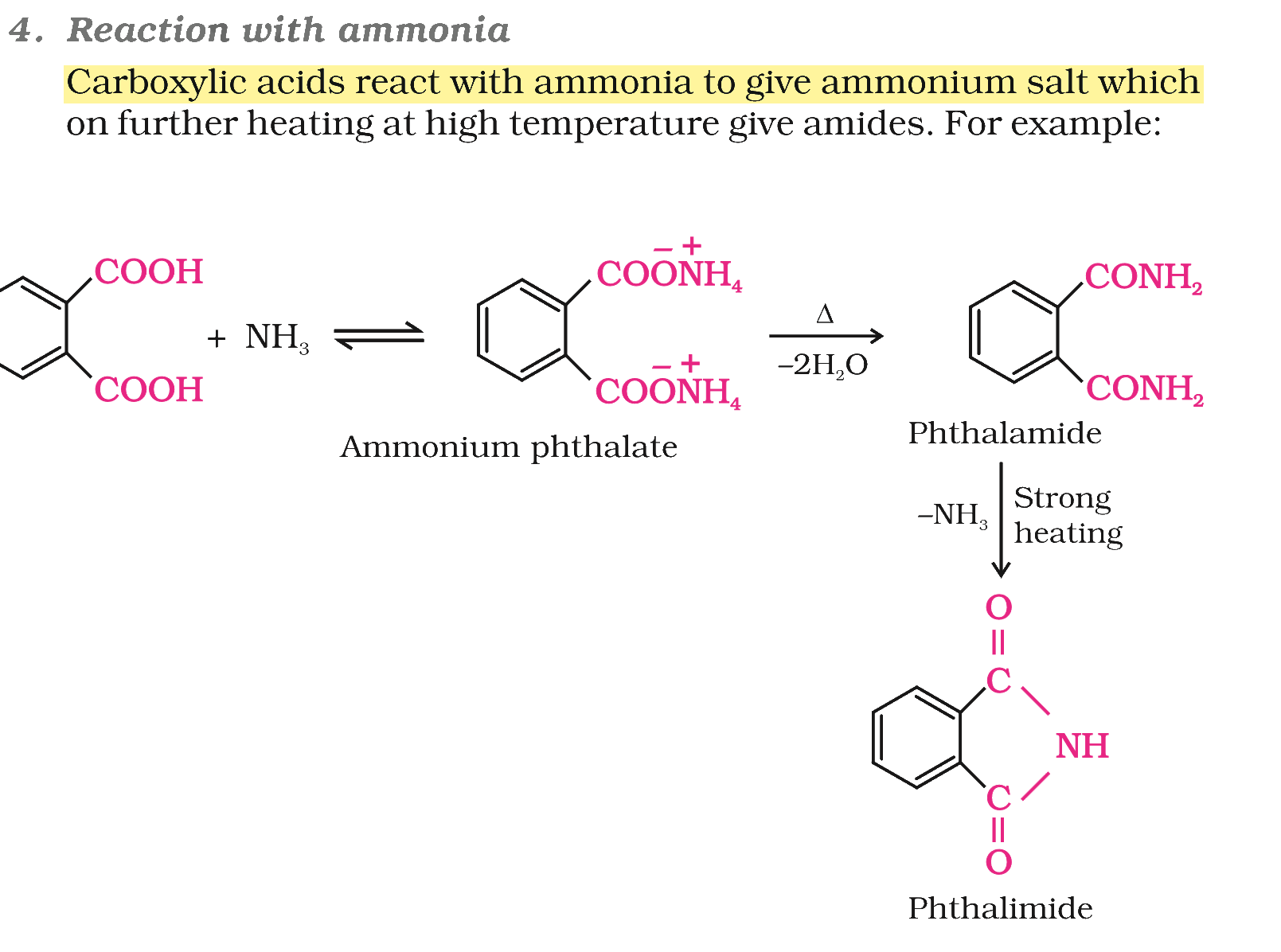
Phthalimide is formed when compound 'A' is treated with ammonia and the resulting compound is heated strongly. The compound 'A' is
Answer & explanation
Correct answer: option 2
The correct answer is Option (2) → benzene-1,2-dicarboxylic acid (phthalic acid)
Carboxylic acids react with ammonia to give ammonium salts, which on strong heating lose water and form amides:
\( \displaystyle \ce{RCOOH + NH3 -> RCOONH4} \xrightarrow{\Delta} \ce{RCONH2 + H2O} \)
An imide has an –NH– group joined to two C=O groups (–CO–NH–CO–). To form a ring imide from one molecule, the two –COOH groups must be close enough to close a five-membered ring, which is possible only when they are on adjacent carbons of the benzene ring. Phthalic acid has this arrangement.
So compound A is phthalic acid (benzene-1,2-dicarboxylic acid), Option (2).
Why the other options are incorrect
Option (1) benzoic acid — Incorrect. It has only one –COOH group, so it gives benzamide (\( \ce{C6H5CONH2} \)), not an imide.
Option (3) 4-chlorobenzoic acid — Incorrect. Again only one –COOH group; the product is 4-chlorobenzamide.
Option (4) 4-carbamoylbenzoic acid — Incorrect. Its two groups are para to each other, on opposite sides of the ring, so they cannot join through one nitrogen to form the five-membered imide ring.
NCERT (2026-27 edition):
Reaction with Ammonia