Match List-I with List-II
| List-I | List-II |
|---|---|
| (A) In this method, the person who purchases a running business must pay in the form of goodwill, a sum which is equal to the profits he is likely to receive for the first few years. | (I) Capitalised value of business |
| (B) It is desirable to value goodwill on the basis of the excess profits and not the actual profits. | (II) Goodwill |
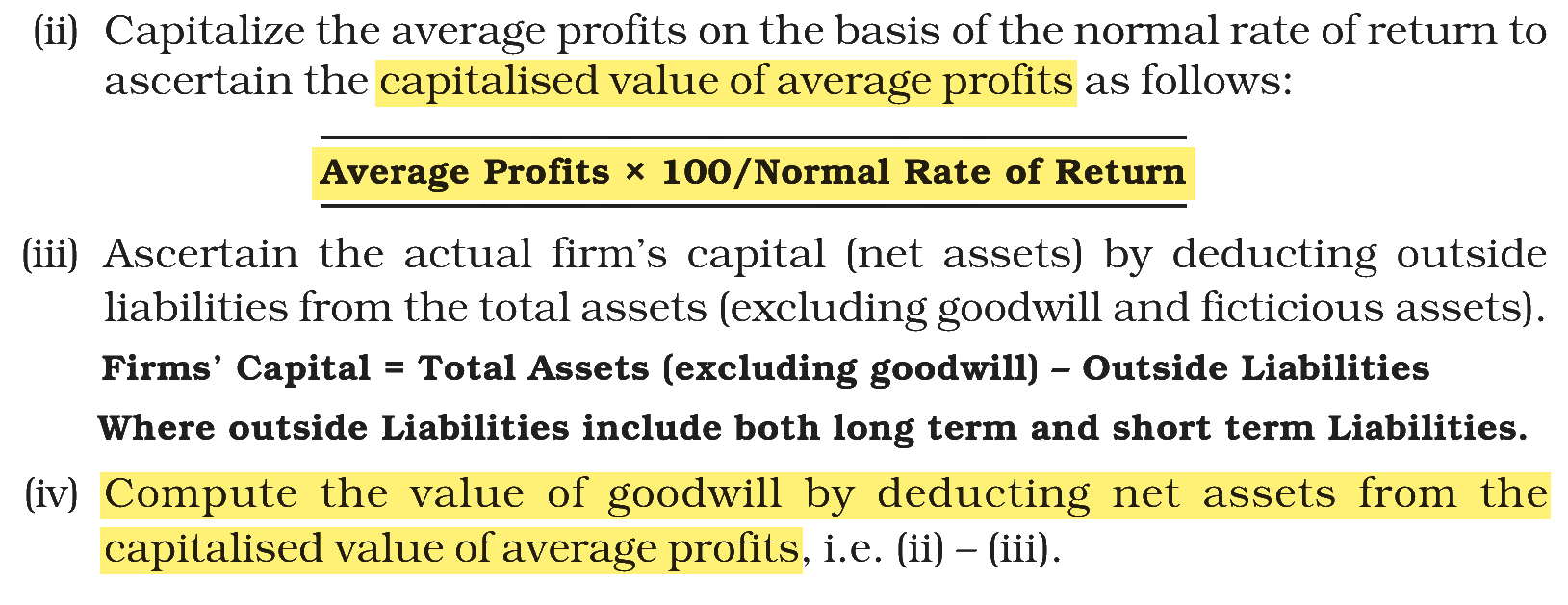
| (C) Average Profits × 100/Normal Rate of Return | (III) Super Profit Method |
| (D) Capitalised value – Net Assets | (IV) Average profit Method |
Choose the correct answer from the options given below:
Answer & explanation
Correct answer: option 3
The correct answer is Option (3) → (A) - (IV), (B) - (III), (C) - (I), (D) - (II)
The items describe the methods of valuing goodwill and the two formulas of the capitalisation method.
(A) In this method, the person who purchases a running business must pay in the form of goodwill, a sum which is equal to the profits he is likely to receive for the first few years. — this matches (IV) Average profit Method. Goodwill is valued at an agreed number of years’ purchase of the average profits, which is the profit the buyer expects for those first few years.
(B) It is desirable to value goodwill on the basis of the excess profits and not the actual profits. — this matches (III) Super Profit Method. The buyer pays only for profits above the normal return, which are the super profits.
(C) Average Profits × 100/Normal Rate of Return — this matches (I) Capitalised value of business. Capitalising the average profit at the normal rate gives the capital needed to earn that profit, which is the value of the whole business.
(D) Capitalised value – Net Assets — this matches (II) Goodwill. Whatever the business is worth beyond its net assets is the value of goodwill.
NCERT (2026-27 edition): NCERT (2026-27 edition): NCERT (2026-27 edition):
|