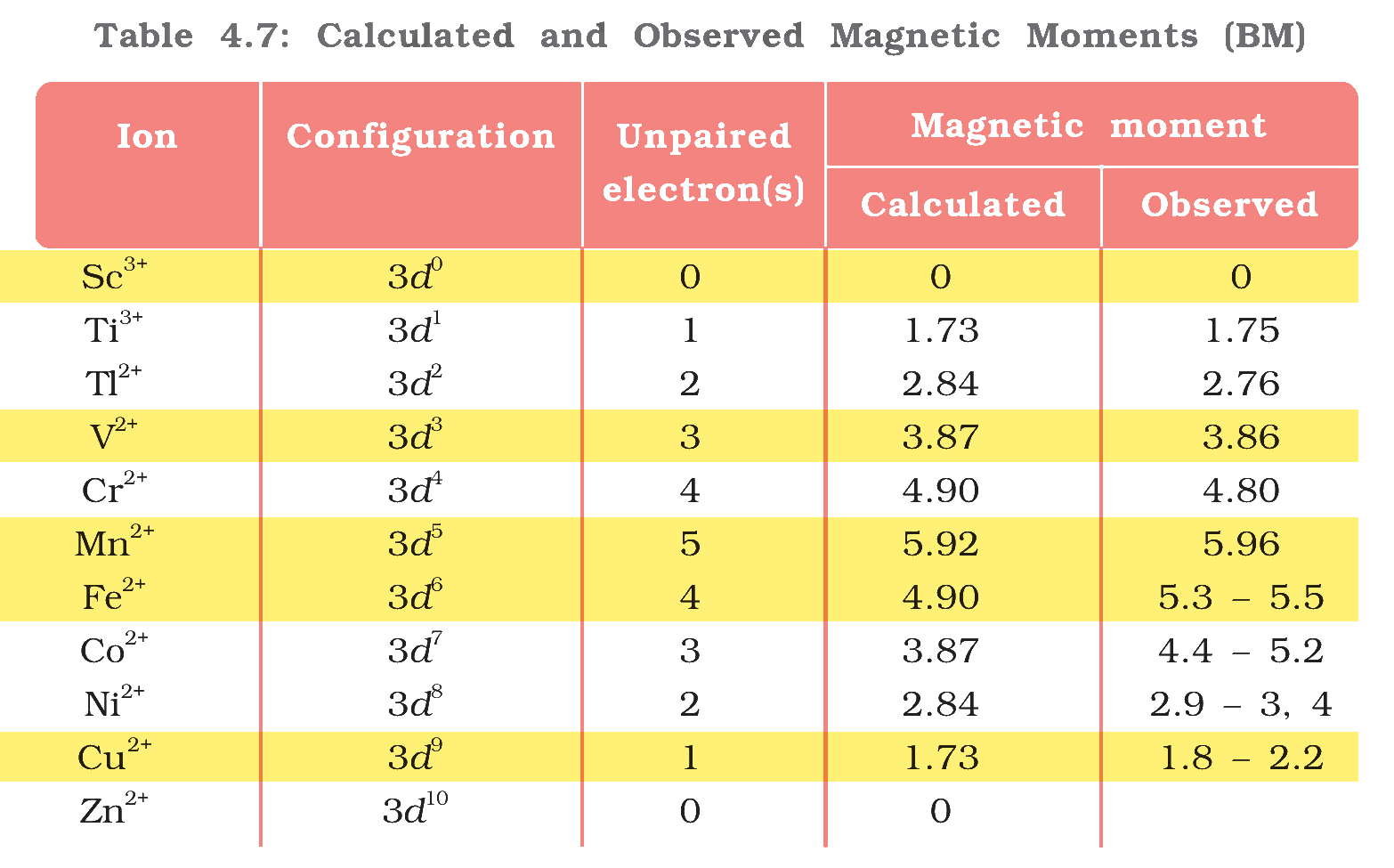
The numbers of unpaired electrons in Fe2+, Mn2+, Cr3+, V5+ and Cu2+ are, respectively:
Answer & explanation
Correct answer: option 1
The correct answer is Option (1) → 4, 5, 3, 0, 1
A transition metal atom loses its 4s electrons first, then 3d electrons. The 3d electrons of the ion then occupy the five 3d orbitals singly first (Hund’s rule) and pair up only after each orbital has one electron.
Fe2+: Fe (Z = 26) is [Ar]3d64s2; losing the two 4s electrons gives 3d6: one pair and four single electrons. 4 unpaired.
Mn2+: Mn (Z = 25) is [Ar]3d54s2; losing the two 4s electrons gives 3d5: one electron in each 3d orbital. 5 unpaired.
Cr3+: Cr (Z = 24) is [Ar]3d54s1; losing the 4s electron and two 3d electrons gives 3d3. 3 unpaired.
V5+: V (Z = 23) is [Ar]3d34s2; losing all five outer electrons gives 3d0. 0 unpaired.
Cu2+: Cu (Z = 29) is [Ar]3d104s1; losing the 4s electron and one 3d electron gives 3d9: four pairs and one single electron. 1 unpaired.
In order: 4, 5, 3, 0, 1. (Cr3+, 3d3, has the same count as V2+, and V5+, 3d0, the same as Sc3+.)
NCERT (2026-27 edition):
4.3.9 Magnetic Properties