
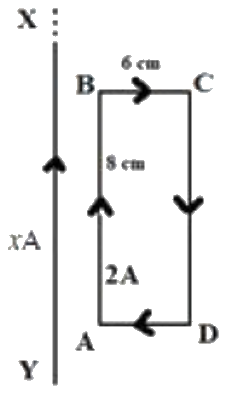
Consider an infinitely long conductor XY carrying current (x) A. A rectangular loop carrying current 2 A is placed parallel to it in the same plane. The two conductors are found to exert a force of \( 1.8 \times 10^{-5} \) N/M. Find the value of x.
Answer & explanation
Correct answer: option 1
The correct answer is Option (1) → 0.6 A
The force between parallel currents is \( F = \mu_0 I_1 I_2 l/(2\pi r) \): attractive when the currents are in the same direction and repulsive when they are opposite. Only the sides of the loop parallel to the wire give a net force.
Readings from the figure:
\( I_{1} = x\,\mathrm{A}\ (\text{wire XY, upwards}) \)
\( I_{2} = 2\,\mathrm{A} \)
\( l = AB = CD = 8\,\mathrm{cm} = 0.08\,\mathrm{m} \)
\( b = BC = 6\,\mathrm{cm} = 0.06\,\mathrm{m} \)
In AB the current flows upwards, the same way as in XY, so AB is attracted. In CD it flows downwards, so CD is repelled. The forces on BC and DA are equal and opposite and cancel.
The figure does not give the distance \( r \) of the near side AB from the wire; CD is then at \( r + b \). The net force (an attraction, since AB is nearer) is
\( \displaystyle F = \frac{\mu_0 x I_{2} l}{2\pi}\left(\frac{1}{r} - \frac{1}{r + b}\right) \)
With \( \mu_0/2\pi = 2\times10^{-7}\,\mathrm{T\,m\,A^{-1}} \) and \( x = 0.6\,\mathrm{A} \):
\( \displaystyle \frac{\mu_0 x I_{2} l}{2\pi} = 2\times10^{-7} \times 0.6 \times 2 \times 0.08 = 1.92\times10^{-8}\,\mathrm{N\,m} \)
Taking the force on the loop as \( F = 1.8\times10^{-5}\,\mathrm{N} \):
\( \displaystyle \frac{1}{r} - \frac{1}{r + 0.06} = \frac{1.8\times10^{-5}}{1.92\times10^{-8}} = 937.5\,\mathrm{m^{-1}} \)
\( \displaystyle \frac{0.06}{r\,(r + 0.06)} = 937.5 \;\Rightarrow\; r^{2} + 0.06\,r - 6.4\times10^{-5} = 0 \)
\( \displaystyle r = \frac{-0.06 + \sqrt{0.0036 + 0.000256}}{2} \approx 1.05\times10^{-3}\,\mathrm{m} \)
So the answer \( x = 0.6\,\mathrm{A} \) is the current for which the side AB is about 0.1 cm (1.05 mm) from the wire.