
CUETMOCK
  • Pricing
  • Mentors
Log inStart freeStart free mocks→

First test, then trust

Try a free CUET mock test.

Join 5,00,000+ students who rehearsed exam day on the exact NTA screen before sitting CUET. On the web and on Android.

Start free mocks →Get the Android app
CUETMOCK

India's #1 CUET Mock Test Platform. Original NCERT-based questions on the exact NTA exam screen — trusted by 5,00,000+ students since CUET 2022.

Get it onGoogle PlayScan to download the CUETMOCK app

Mock tests

  • CUET mock test series
  • Browse all papers
  • Commerce mocks
  • Humanities (Arts) mocks
  • Science mocks
  • Languages & GAT mocks
  • Free practice questions
  • Pricing

Resources

  • CUET exam guide
  • CUET syllabus
  • Universities accepting CUET
  • Expert blogs
  • News & notifications
  • Webinars & counselling
  • CUET score calculator
  • How we estimate your rank
  • FAQs

Company

  • About us
  • Our leadership & team
  • Our toppers
  • Mentors
  • For schools
  • Contact us
  • Terms
  • Privacy
  • Refund policy

Talk to us

+91 7696 6630 56info@cuetmock.comWhatsApp us

Our other platforms

  • JEE Mock — For IIT-JEE aspirants
  • NEET Mock — For NEET aspirants

Newsletter

Exam updates, study material and offers — no spam.

© 2026 NYC Ventures Pvt. Ltd.

701-702, Royal Business Park, Zirakpur, Punjab - 140603

  • Terms of use
  • Privacy policy
  • Refund policy
  • Contact us

iCUETMOCK is an independent preparation platform, not affiliated with the National Testing Agency (NTA). Always check exam details on the official NTA website.

  • Home
  • Mock tests
  • CUET guide
  • Pricing
  • Log in
Home/Practice questions/Chemistry
ChemistryPhysical: Chemical Kinetics

Rate constant ‘k’ for a certain reaction is k = 2.3 × 10⁻⁵ L mol−1 s−…

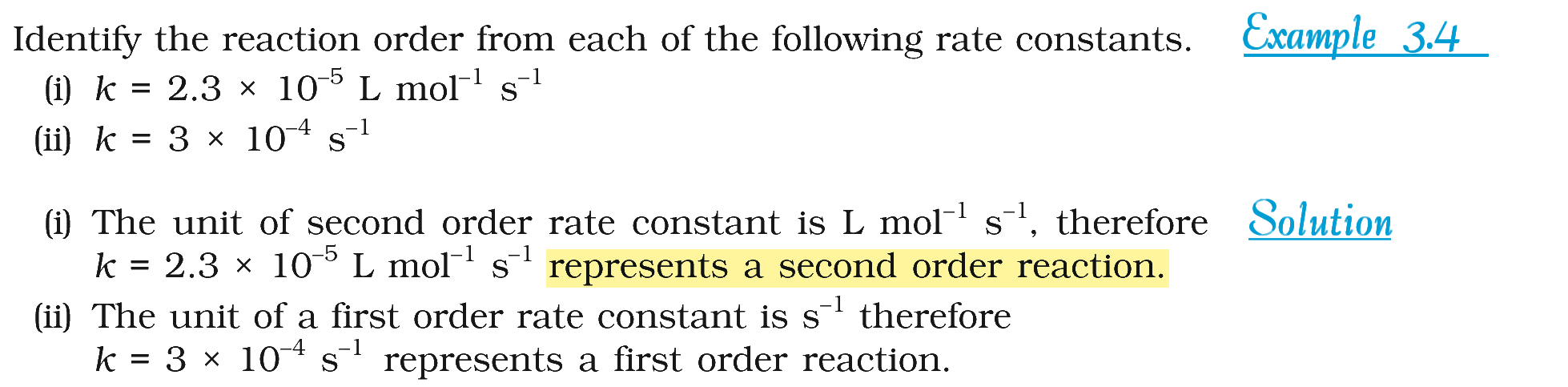
Rate constant ‘k’ for a certain reaction is k = 2.3 × 10⁻⁵ L mol−1 s−1. Order of the reaction is:

Answer & explanation+

Correct answer: option 3

The correct answer is Option (3) → 2

The unit of the rate constant depends on the order of the reaction. For an nth order reaction:

    \( \displaystyle k = \frac{\text{rate}}{[\text{A}]^n} = \frac{\text{mol L}^{-1}\,\text{s}^{-1}}{(\text{mol L}^{-1})^n} = (\text{mol L}^{-1})^{1-n}\,\text{s}^{-1} \)

The given unit is L mol−1 s−1 = (mol L−1)−1 s−1, so

    \( 1 - n = -1 \;\Rightarrow\; n = 2 \)

The reaction is of the second order.

Note: This question is from NCERT (2026-27). NTA sets numerical questions from NCERT too, so do not ignore NCERT while practising numericals.

NCERT (2026-27 edition):
Order of a Reaction – …
Textbook extract

Advertisement

Practise more on Physical: Chemical Kinetics

Chapter-wise mocks on the real NTA exam screen, with solutions and your rank. Your first mocks are free.

Start free mocks →

Advertisement

Next questions

  1. Which part of Brahman's body are the 'Kshatriya' believed to have been created from, as per Al-Biruni's account?History · Medieval India: Through the Eyes of Travellers
  2. If A = […] , then |A^-1| is equal toApplied Maths. Section A · Determinants
  3. The Chipko Movement is an example ofSociology · Social Change and Development in India: Social Movements
  4. In a school, there are 1000 students, out of which 430 are girls. It is known that out of 430, 10% of the girls study in class XII. What is…Maths. Section B1 · Probability
  5. To understand interpersonal physical distance as given by Edward Hall, align the following from the least to the maximum distance. (A) Pers…Psychology · Psychology and Life
  6. Calculate current ratio when : Total asset ₹ 3,00,000 Fixed asset ₹ 1,60,000 Non current investments ₹ 1,00,000 Non-current Liabilities ₹ 8…Accountancy Part B · Accounting Ratios
  7. In the figure below, output is on the X-axis and cost is on the Y-axis.What are curve 1 and the area of the rectangle OFCq1?Economics · Micro Economics: Production and Costs
  8. Before starting her science project, Meera sits down and decides which topic to take up, what steps to follow and in what order. She also w…Psychology · Variations in Psychological Attributes
  9. Select the option that is related to the third number on the same basis as the second number is related to the first number. 7 : 42 :: 9 : ?General Aptitude Test · General Ability
  10. If A : B = 3 : 2, B : C = 7 : 5 and C : D = 10 : 3, then what is A : D equal to?General Aptitude Test · Numerical Ability