CUETMOCK
  • Pricing
  • Mentors
Log inStart freeStart free mocks→

First test, then trust

Try a free CUET mock test.

Join 5,00,000+ students who rehearsed exam day on the exact NTA screen before sitting CUET. On the web and on Android.

Start free mocks →Get the Android app
CUETMOCK

India's #1 CUET Mock Test Platform. Original NCERT-based questions on the exact NTA exam screen — trusted by 5,00,000+ students since CUET 2022.

Get it onGoogle PlayScan to download the CUETMOCK app

Mock tests

  • CUET mock test series
  • Browse all papers
  • Commerce mocks
  • Humanities (Arts) mocks
  • Science mocks
  • Languages & GAT mocks
  • Free practice questions
  • Pricing

Resources

  • CUET exam guide
  • CUET syllabus
  • Universities accepting CUET
  • Expert blogs
  • News & notifications
  • Webinars & counselling
  • CUET score calculator
  • How we estimate your rank
  • FAQs

Company

  • About us
  • Our leadership & team
  • Our toppers
  • Mentors
  • For schools
  • Contact us
  • Terms
  • Privacy
  • Refund policy

Talk to us

+91 7696 6630 56info@cuetmock.comWhatsApp us

Our other platforms

  • JEE Mock — For IIT-JEE aspirants
  • NEET Mock — For NEET aspirants

Newsletter

Exam updates, study material and offers — no spam.

© 2026 NYC Ventures Pvt. Ltd.

701-702, Royal Business Park, Zirakpur, Punjab - 140603

  • Terms of use
  • Privacy policy
  • Refund policy
  • Contact us

iCUETMOCK is an independent preparation platform, not affiliated with the National Testing Agency (NTA). Always check exam details on the official NTA website.

  • Home
  • Mock tests
  • CUET guide
  • Pricing
  • Log in
Home/Practice questions/Chemistry
ChemistryOrganic: Alcohols, Phenols and Ethers

Match List I with List II List I List II (A) (I) (B) (II) (C) (III) (…

Match List I with List II

List I List II
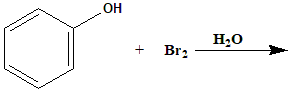
(A) Figure for Q19 (I) Figure for Q19
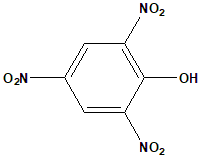
(B) Figure for Q19 (II) Figure for Q19
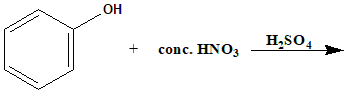
(C) Figure for Q19 (III) Figure for Q19
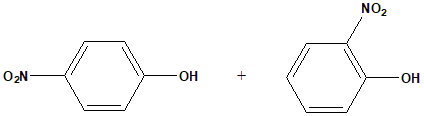
(D) Figure for Q19 (IV) Figure for Q19

Choose the correct answer from the options given below:

Answer & explanation+

Correct answer: option 2

The correct answer is Option (2) → A-IV, B-I, C-III, D-II

The –OH group strongly activates the benzene ring and directs the incoming group to the ortho and para positions. How many groups enter depends on the conditions: mild conditions give mono-substitution, while bromine water or concentrated nitric acid substitute all three o/p positions.

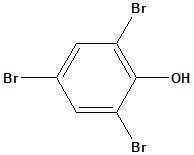
  • (A) Phenol + \( \ce{Br2} \), \( \ce{H2O} \) — This matches (IV) 2,4,6-tribromophenol. In water (a polar solvent) bromine is strongly polarised and every ortho and para position is brominated; a white precipitate forms.

        \( \ce{C6H5OH + 3Br2} \xrightarrow{\ce{H2O}} \ce{C6H2Br3OH v + 3HBr} \)

  • (B) Phenol + conc. \( \ce{HNO3} \), \( \ce{H2SO4} \) — This matches (I) 2,4,6-trinitrophenol (picric acid). Concentrated nitric acid nitrates all three ortho and para positions.

        \( \ce{C6H5OH + 3HNO3} \xrightarrow{\text{conc. }\ce{H2SO4}} \ce{C6H2(NO2)3OH + 3H2O} \)

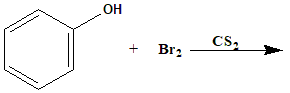
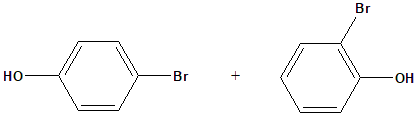
  • (C) Phenol + \( \ce{Br2} \), \( \ce{CS2} \) — This matches (III) o- and p-bromophenol. In a solvent of low polarity (\( \ce{CS2} \), \( \ce{CHCl3} \)) at low temperature, only monobromophenols form, mainly the para isomer.

        \( \ce{C6H5OH + Br2} \xrightarrow{\ce{CS2}, \ 273\,\mathrm{K}} \ce{BrC6H4OH + HBr} \)

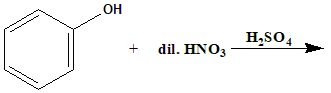
  • (D) Phenol + dil. \( \ce{HNO3} \) — This matches (II) o- and p-nitrophenol. Dilute nitric acid at low temperature (298 K) gives a mixture of ortho- and para-nitrophenols, separated by steam distillation.

        \( \ce{C6H5OH + HNO3} \xrightarrow{\text{dil., }298\,\mathrm{K}} \ce{O2NC6H4OH + H2O} \)

NCERT (2026-27 edition):
Electrophilic Aromatic Substitution – “… (i) Nitration: With dilute nitric acid at low temperature (298 K), phenol yields a mixture of ortho and para nitrophenols. … With concentrated nitric acid, phenol is converted to 2,4,6-trinitrophenol. The product is commonly known as picric acid.”

Electrophilic Aromatic Substitution – “… (ii) Halogenation: On treating phenol with bromine, different reaction products are formed under different experimental conditions. (a) When the reaction is carried out in solvents of low polarity such as CHCl3 or CS2 and at low temperature, monobromophenols are formed. … (b) When phenol is treated with bromine water, 2,4,6-tribromophenol is formed as white precipitate.”

Advertisement

Practise more on Organic: Alcohols, Phenols and Ethers

Chapter-wise mocks on the real NTA exam screen, with solutions and your rank. Your first mocks are free.

Start free mocks →

Advertisement

Next questions

  1. बच्चे खेल रहे हैं | (कर्मवाच्य बनाइए )Hindi · व्याकरण - वाच्य
  2. Which of the following items is shown under the head ‘Non-Current Assets’, while preparing the Balance sheet of a company?Accountancy Part B · Financial Statements of a Company
  3. Assertion:. Watershed management basically refers to efficient management and conservation of surface and groundwater resources. Reasoning:…Geography · India-People and Economy: Water resources
  4. If x + y + z = 5, 1/x+1/y+1/z = 0, xyz = 12 and x^3 + y^3 + z^3 = 151, then the value of (x^2 + y^2 = z^2) is :General Aptitude Test · Quantitative Reasoning
  5. Select the correct active form of the given sentence: Why was such a letter written by your brother?English · Grammar: Active Passive Voice
  6. If (sinθ + cosθ) = sqrt 2 ; 0 < θ < 90°, then value of θ is:General Aptitude Test · Quantitative Reasoning
  7. What did James Fergusson, an early modern art historian, consider Sanchi to be associated with?History · Ancient India: Thinkers, Beliefs and Buildings
  8. An elevator starts with m passengers and stops at n floors (m ≤ n).the probability that no two passengers alight at same floor is:Maths. Section B1 · Probability
  9. A transformer steps up from 110V to 1320V. What is the transformation ratio?Physics · Electromagnetic Induction
  10. In 1977, who became the President of the Janata Party, which formed a coalition government at the centre with Morarji Desai as the Prime Mi…General Aptitude Test · General Knowledge