Given below are two statements:
Statement I: Decoding is the process of converting the encoded symbols of the sender.
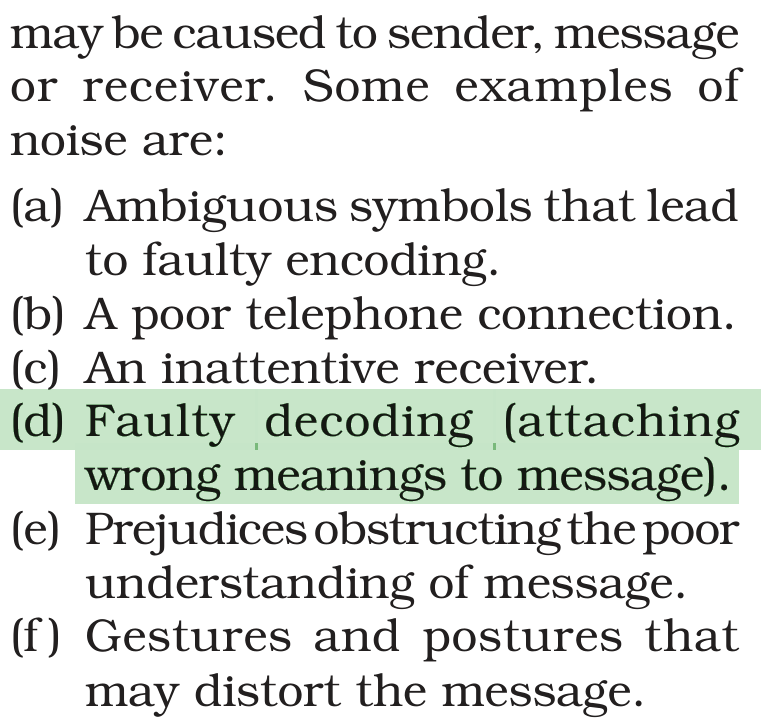
Statement II: Faulty decoding, that is attaching wrong meanings to the message, is an example of noise in communication.
In the light of the above statements, choose the correct answer from the options given below:
Answer & explanation
Correct answer: option 1
The correct answer is Option (1) → Both Statement I and Statement II are correct.
Statement I: Decoding is the process of converting the encoded symbols of the sender. — Correct. The sender first turns his message into symbols such as words, pictures or gestures; this is encoding. The receiver then converts these encoded symbols back into meaning; this is decoding.
Statement II: Faulty decoding, that is attaching wrong meanings to the message, is an example of noise in communication. — Correct. Noise means any obstruction or hindrance to communication. When the receiver attaches a wrong meaning to the message, the message does not get through as sent. So faulty decoding is one of the examples of noise.
NCERT (2026-27 Edition): “(iv) Media: It is the path through which encoded message is transmitted to receiver. The channel may be in written form, face to face, phone call, Internet etc., “(viii) Noise: Noise means some obstruction or hindrance to communication. …”
|