Read the following passage carefully and answer the given questions.
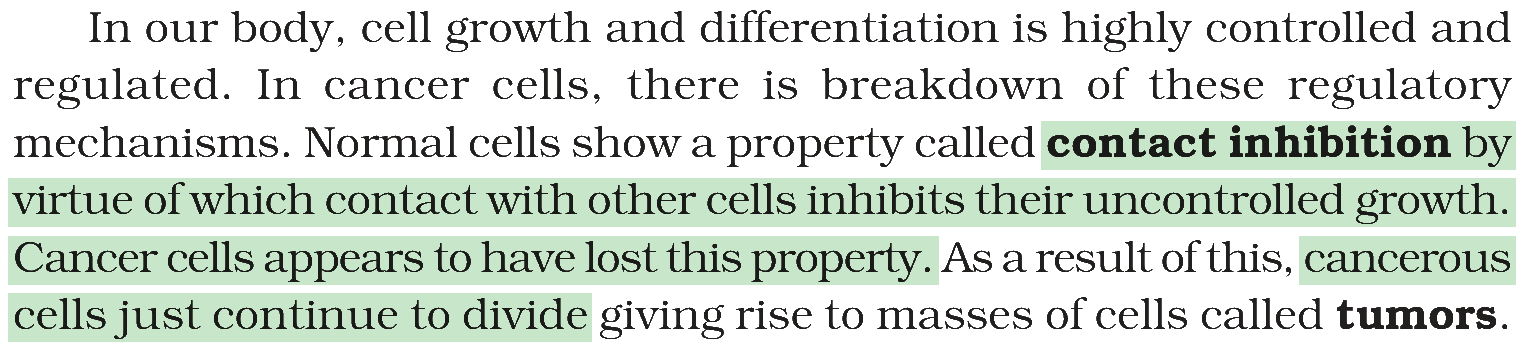
Cancerous cells just continue to divide giving rise to masses of cells called tumors. Benign tumors normally remain confined to their original location and do not spread to other parts of the body and cause little damage. The malignant tumors, on the other hand are a mass of proliferating cells called neoplastic or tumor cells. Transformation of normal cells into cancerous neoplastic cells may be induced by physical, chemical or biological agents. Ionising radiations like X-rays and gamma rays and non-ionizing radiations like UV cause cancer. Cancer-causing viruses are called oncogenic viruses which have viral oncogenes. The substances to which an immune response is produced are called allergens. The antibodies produced to these are of IgE type. Common examples of allergens are mites in dust, pollens, animal dander, etc. The primary lymphoid organs are bone marrow and thymus. The secondary lymphoid organs provide the sites for interaction of lymphocytes with the antigen, which then proliferate to become effector cells.
Cancer cells divide without any control due to:
Answer & explanation
Correct answer: option 4
The correct answer is Option (4) → Loss of contact inhibition between cells
Option (1) Presence of contact inhibition between cells — Incorrect. Contact inhibition is present in normal cells. It is the very property that keeps their growth in check, so its presence cannot be the reason for uncontrolled division.
Option (2) No contact between the cells — Incorrect. Cancer cells are in contact with one another; they pile up into masses called tumors. The problem is not the lack of contact but that contact no longer stops their division.
Option (3) Loss of DNA transcription — Incorrect. A cell that cannot transcribe its DNA cannot make its proteins. Such a cell could not grow or divide at all, let alone divide without control.
Option (4) Loss of contact inhibition between cells — Correct. A cancer cell no longer stops dividing when it touches its neighbours. So it goes on dividing and forms a tumor.
Note: The passage is taken from NCERT. NTA has put lines of the NCERT text together to make it. Most CUET (UG) questions come straight from NCERT, so study the book line by line, including figures and their titles.
NCERT Extract:
Cancer – …