Health and diseases
Read the following passage carefully and answer the given questions.
Health is not just the absence of disease. It is a state of complete physical, mental, social and psychological well-being. Diseases like typhoid, cholera, pneumonia, fungal infections of skin, malaria and many others are a major cause of distress to human beings. When the functioning of one or more organs or systems of the body is adversely affected, characterised by appearance of various signs and symptoms, we say that we are not healthy, i.e., we have a disease. Our immune system plays the major role in preventing these diseases when we are exposed to disease-causing agents. Immune system has memory. On subsequent exposure to same pathogen, the immune response is rapid and more intense. This forms the basis of protection afforded by vaccination and immunisation. Among other diseases, AIDS and cancer kill a large number of individuals worldwide. Many cancers are curable if detected early and appropriate therapeutic measures are taken.
Which one of the following diseases is spread by a vector?
Answer & explanation
Correct answer: option 4
The correct answer is Option (4) → Malaria
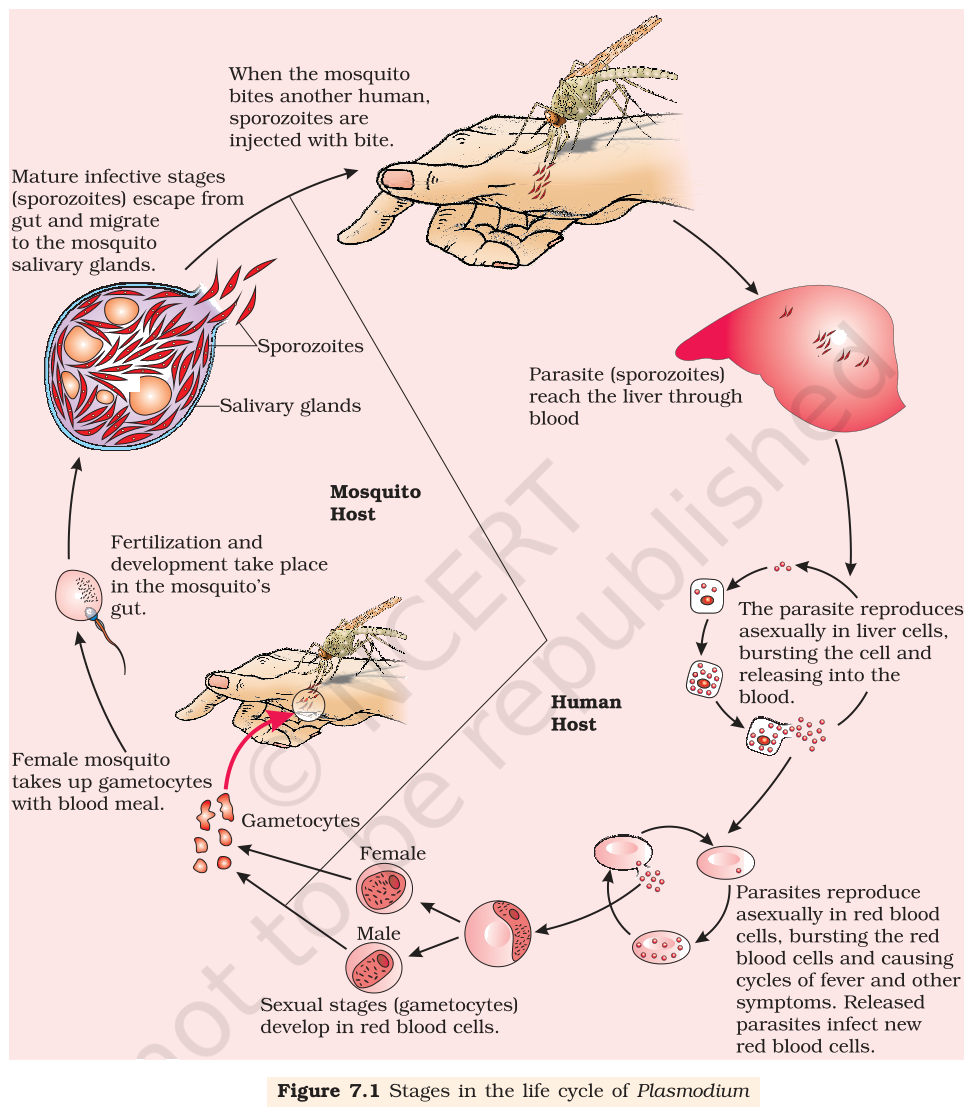
A vector is an animal that carries a disease-causing organism from one host to another. The malarial parasite needs two hosts, human and mosquito. The female Anopheles mosquito is the vector.
(1) Diphtheria — Incorrect. It is a bacterial disease. NCERT lists it among the bacterial diseases of man, and no vector is involved.
(2) Pneumonia — Incorrect. It is caused by bacteria such as Streptococcus pneumoniae that infect the lungs. It spreads by droplets from an infected person and not through a vector.
(3) AIDS — Incorrect. AIDS (Acquired Immuno Deficiency Syndrome) is caused by HIV (Human Immuno deficiency Virus). HIV spreads through body fluids, such as by sexual contact or infected blood. No vector is involved.
(4) Malaria — Correct. It is carried by the female Anopheles mosquito.
Note: The passage is taken from NCERT. NTA has put lines of the NCERT text together to make it. Most CUET (UG) questions come straight from NCERT, so study the book line by line, including figures and their titles.
NCERT Extract:
Common Diseases in Humans – “… When these mosquitoes bite a human, the sporozoites are introduced into his/ her body, thereby initiating the events mentioned above. It is interesting to note that the malarial parasite requires two hosts – human and mosquitoes – to complete its life cycle (Figure 7.1); the female Anopheles mosquito is the vector (transmitting agent) too.”