Match the LIST-I with LIST-II
| LIST-I (Political development) | LIST-II (Year) | ||
| A. | Jayaprakash Narayan led a peoples’ march to the Parliament | I. | 1973 |
| B. | The Constitution bench of the Supreme Court ruled that during Emergency the government could take away the citizen’s right to life and liberty | II. | 1975 |
| C. | Keshavananda Bharati Case | III. | 1963 |
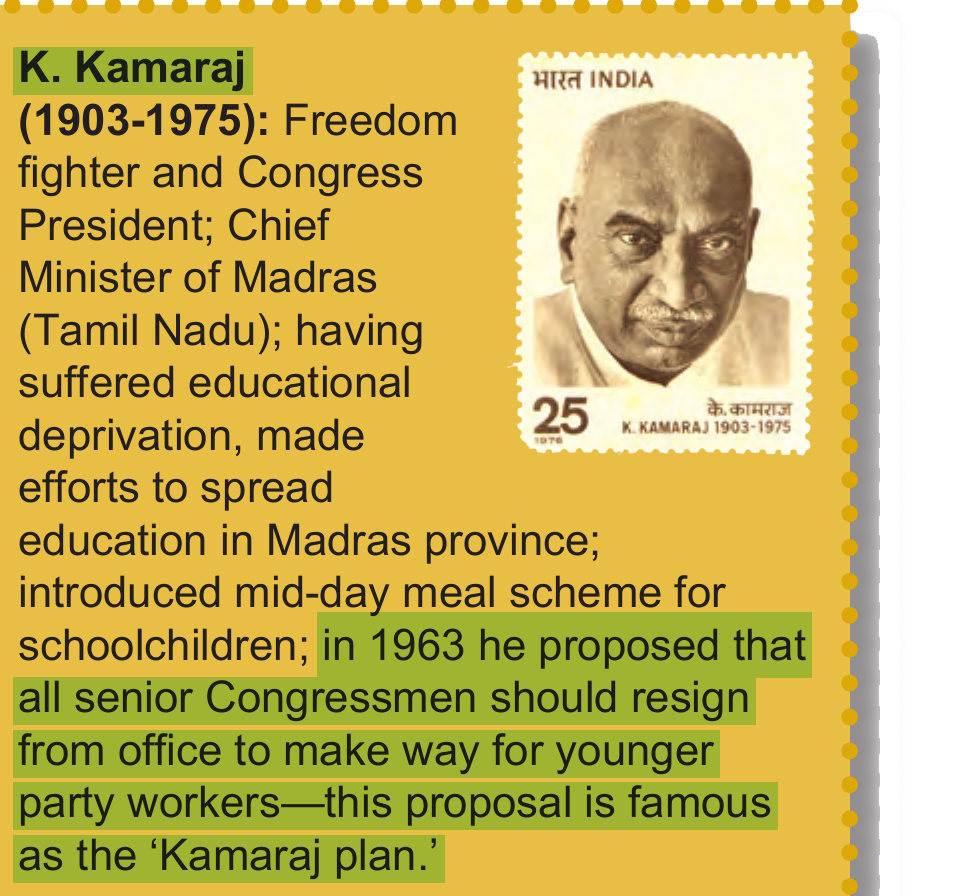
| D. | K. Kamaraj proposed the Kamaraj Plan | IV. | 1976 |
Choose the correct answer from the options given below:
Answer & explanation
Correct answer: option 2
The correct answer is Option (2) → A – II, B – IV, C – I, D – III
(A) Jayaprakash Narayan led a peoples’ march to the Parliament — this matches (II) 1975.
(B) The Constitution bench of the Supreme Court ruled that during Emergency the government could take away the citizen’s right to life and liberty — this matches (IV) 1976. The judgment came in April 1976.
(C) Keshavananda Bharati Case — this matches (I) 1973.
(D) K. Kamaraj proposed the Kamaraj Plan — this matches (III) 1963.
NCERT (2025-26): “Gujarat and Bihar movements … Alongside the agitation led by Jayaprakash Narayan, the employees of the Railways gave a call for a nationwide strike. This threatened to paralyse the country. In 1975, JP led a peoples’ march to the Parliament. This was one of the largest political rallies ever held in the capital.… Conflict with Judiciary … Immediately after the Supreme Court’s decision in 1973 in the Keshavananda Bharati case, a vacancy arose for the post of the Chief Justice of India. It had been a practice to appoint the senior-most judge of the Supreme Court as the Chief Justice. But in 1973, the government set aside the seniority of three judges and appointed Justice A. N. Ray as the Chief Justice of India.… Consequences … Several High Courts gave judgments that even after the declaration of Emergency the courts could entertain a writ of habeas corpus filed by a person challenging his/her detention. In April 1976, the constitution bench of the Supreme Court over-ruled the High Courts and accepted the government’s plea. It meant that during Emergency the government could take away the citizen’s right to life and liberty.…”
|