Vaccination is a type of:
Answer & explanation
Correct answer: option 1
The correct answer is Option (1) → Passive immunity
Note: The given answer is as per the official NTA Answer Key. However, there seems to be a mistake in the question. According to NCERT, vaccination gives active immunity, so the correct answer is Option (2), as explained below.
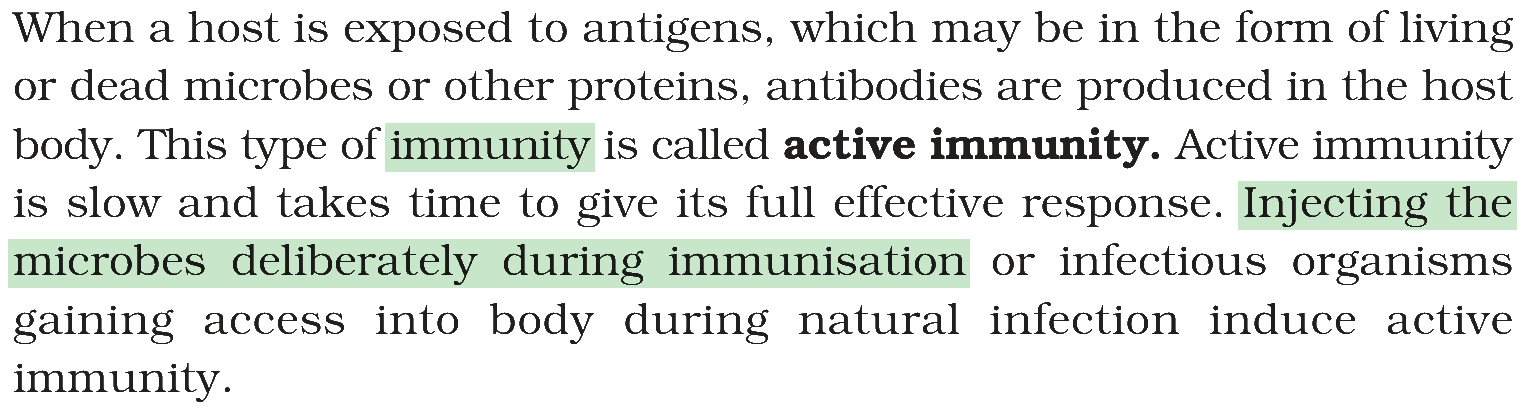
Immunity is active when the body itself makes the antibodies after it meets antigens. It is slow, but it also leaves memory B and T cells. Immunity is passive when ready-made antibodies are given to the body, for example the antibodies of colostrum or an antivenom injection.
(1) Passive immunity — Answer given by NTA; however, it is not correct. A vaccine contains antigenic proteins of a pathogen, or an inactivated or weakened pathogen. No ready-made antibodies are given. NCERT uses the term passive immunisation only for injected, preformed antibodies.
(2) Active immunity — Correct as per NCERT. A vaccine makes the body produce its own antibodies and memory cells. NCERT says that injecting microbes deliberately during immunisation induces active immunity.
(3) Cell mediated immunity — Incorrect. This is the response of T-lymphocytes, which is also responsible for graft rejection. It is part of the acquired immune response and is not the type of immunity that vaccination is classified as.
(4) Autoimmunity — Incorrect. In autoimmunity the body attacks its own cells. A vaccine does the opposite. It prepares the body against a pathogen.
NCERT Extract:
Active and Passive Immunity –