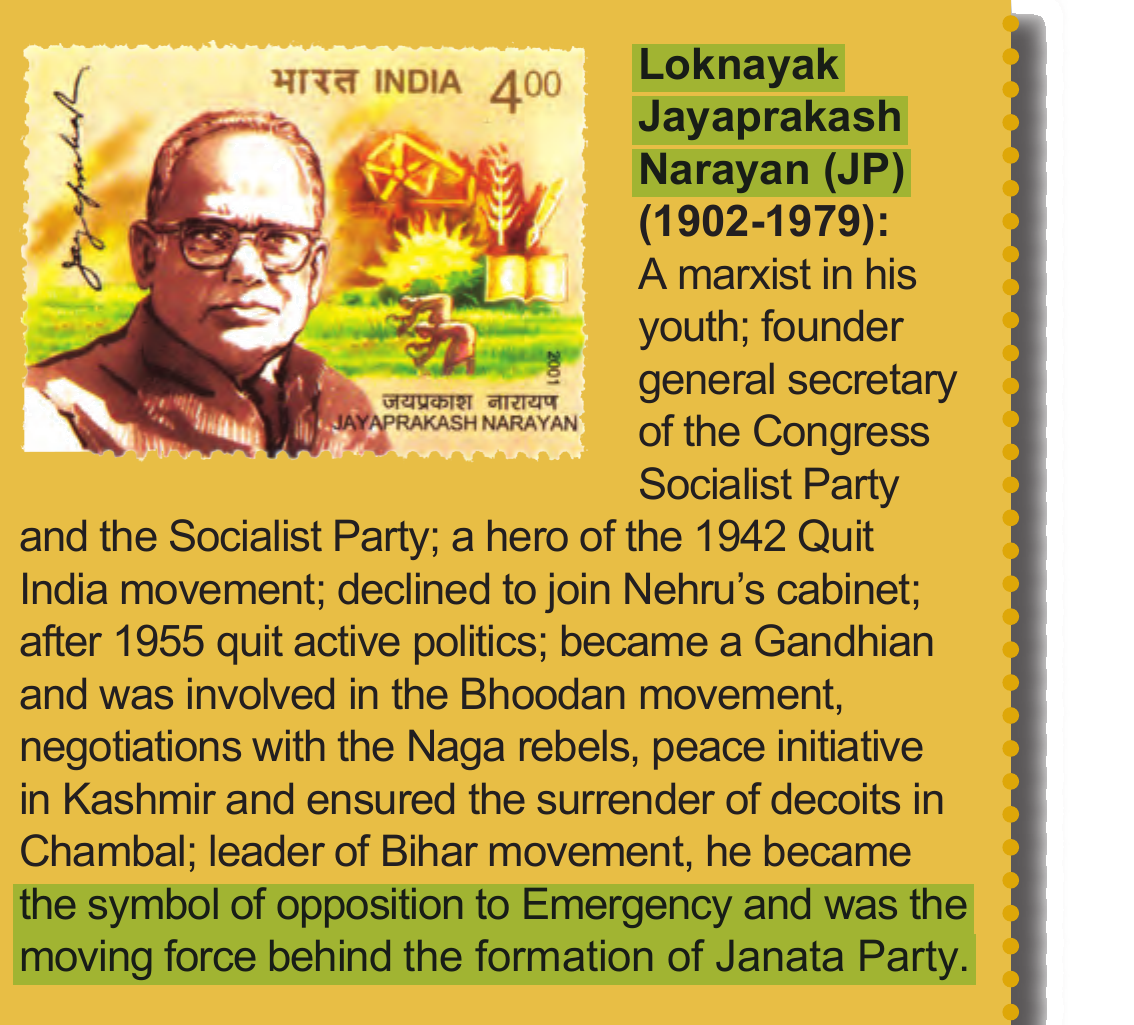
Match List-I with List-II
| List-I (Leaders) | List-II (Associated with party or event) | ||
| (A) | Morarji Desai | (I) | leader of the Lok Dal |
| (B) | Jayaprakash Narayan | (II) | a prominent leader of Congress (O) |
| (C) | Jagjivan Ram | (III) | force behind the formation of Janata Party. |
| (D) | Chaudhary Charan Singh | (IV) | leader of Congress for Democracy |
Choose the correct answer from the options given below:
Answer & explanation
Correct answer: option 2
The correct answer is Option (2) → (A) – (II), (B) – (III), (C) – (IV), (D) – (I)
(A) Morarji Desai — this matches (II) a prominent leader of Congress (O).
(B) Jayaprakash Narayan — this matches (III) force behind the formation of Janata Party.
(C) Jagjivan Ram — this matches (IV) leader of Congress for Democracy. The party later merged with the Janata Party.
(D) Chaudhary Charan Singh — this matches (I) leader of the Lok Dal. Its full name was the Bharatiya Lok Dal.
NCERT (2025-26): “Gujarat and Bihar movements … The opposition parties demanded fresh elections to the state legislature. Morarji Desai, a prominent leader of Congress (O), who was the main rival of Indira Gandhi when he was in the Congress, announced that he would go on an indefinite fast if fresh elections were not held in the State.… Politics after Emergency … Some other Congress leaders also came out and formed a separate party under the leadership of Jagjivan Ram. This party named as Congress for Democracy, later merged with the Janata Party.… Janata Government … After the election, there was stiff competition among three leaders for the post of Prime Minister – Morarji Desai, who was the rival to Indira Gandhi ever since 1966-67; Charan Singh, leader of the Bharatiya Lok Dal and a farmers’ leader from UP; and Jagjivan Ram, who had vast experience as a senior minister in the Congress governments.…”
|