The firm's total variable cost at output \( q_1 \) is
Answer & explanation
Correct answer: option 2
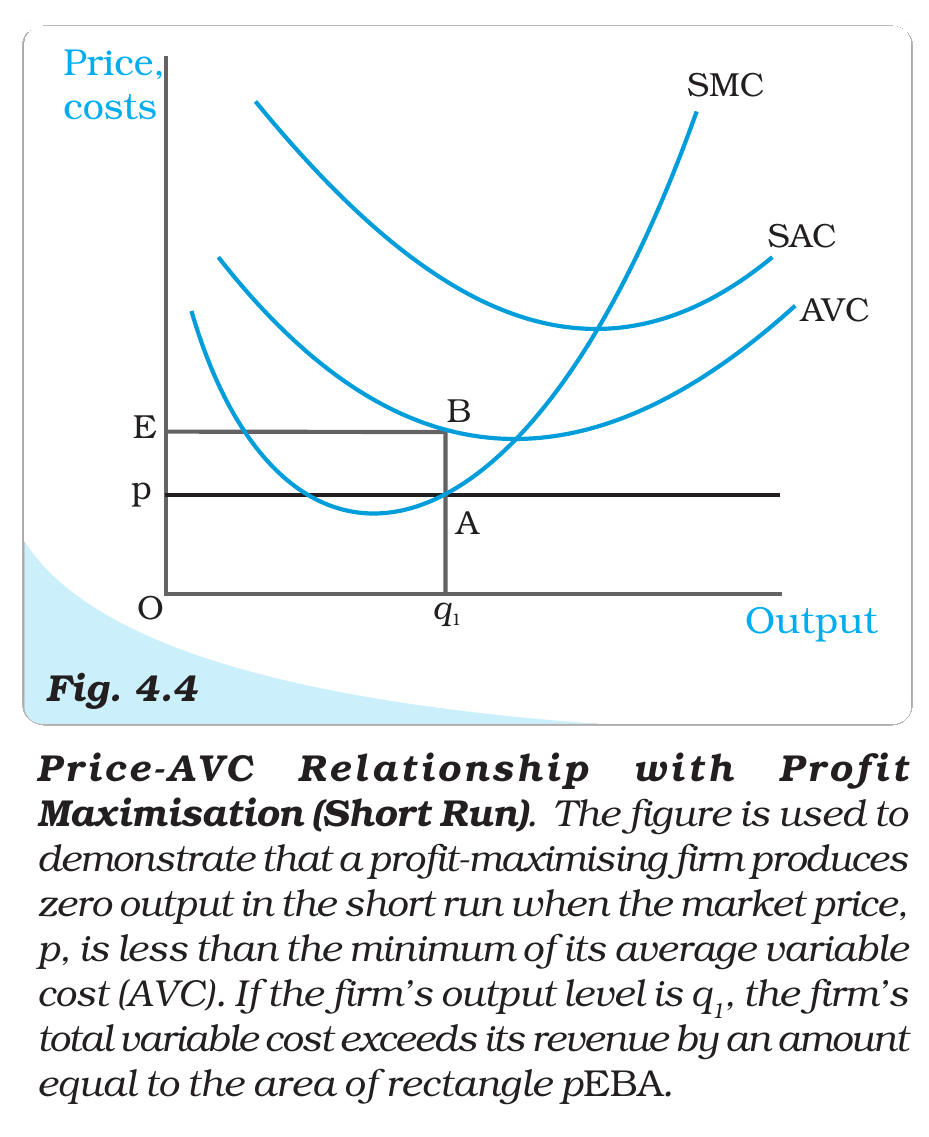
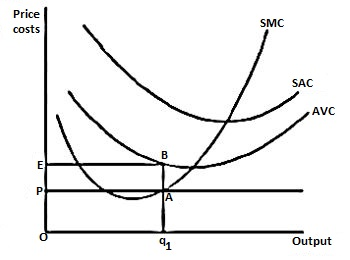
The correct answer is Option (2) → The area of rectangle \( OEBq_1 \)
Total variable cost (TVC) is average variable cost (AVC) multiplied by quantity. At output \( q_1 \), the AVC curve is at B, so AVC is the vertical height OE. The quantity is the width \( Oq_1 \). So TVC is the area of rectangle \( OEBq_1 \).
Option (1) The area of rectangle \( OpAq_1 \) — Incorrect. Its height is the price and its width is the quantity. So this area is total revenue.
Option (2) The area of rectangle \( OEBq_1 \) — Correct. Its height is AVC and its width is the quantity.
Option (3) the area of rectangle \( OpAq_1 \) - the area of rectangle \( OEBq_1 \) — Incorrect. This is total revenue minus TVC. It tells how far revenue falls short of TVC at this output.
Option (4) \( \tan \theta \) — Incorrect. The tangent of an angle gives a slope. A total cost in this figure is an area.
NCERT (2026-27): “Case 1: Price must be greater than or equal to AVC in the short run … Let us turn to Figure 4.4. Observe that at the output level q1, the market price p is lower than the AVC. We claim that q1 cannot be a profit-maximising output level.…Notice that the firm’s total revenue at q1 is as follows TR = Price × Quantity Similarly, the firm’s total variable cost at q1 is as follows TVC = Average variable cost × Quantity Now recall that the firm’s profit at q1 is TR – (TVC + TFC); that is, [the area of rectangle OpAq1] – [the area of rectangle OEBq1] – TFC.…”
|