CUETMOCK
  • Pricing
  • Mentors
Log inStart freeStart free mocks→

First test, then trust

Try a free CUET mock test.

Join 5,00,000+ students who rehearsed exam day on the exact NTA screen before sitting CUET. On the web and on Android.

Start free mocks →Get the Android app
CUETMOCK

India's #1 CUET Mock Test Platform. Original NCERT-based questions on the exact NTA exam screen — trusted by 5,00,000+ students since CUET 2022.

Get it onGoogle PlayScan to download the CUETMOCK app

Mock tests

  • CUET mock test series
  • Browse all papers
  • Commerce mocks
  • Humanities (Arts) mocks
  • Science mocks
  • Languages & GAT mocks
  • Free practice questions
  • Pricing

Resources

  • CUET exam guide
  • CUET syllabus
  • Universities accepting CUET
  • Expert blogs
  • News & notifications
  • Webinars & counselling
  • CUET score calculator
  • How we estimate your rank
  • FAQs

Company

  • About us
  • Our leadership & team
  • Our toppers
  • Mentors
  • For schools
  • Contact us
  • Terms
  • Privacy
  • Refund policy

Talk to us

+91 7696 6630 56info@cuetmock.comWhatsApp us

Our other platforms

  • JEE Mock — For IIT-JEE aspirants
  • NEET Mock — For NEET aspirants

Newsletter

Exam updates, study material and offers — no spam.

© 2026 NYC Ventures Pvt. Ltd.

701-702, Royal Business Park, Zirakpur, Punjab - 140603

  • Terms of use
  • Privacy policy
  • Refund policy
  • Contact us

iCUETMOCK is an independent preparation platform, not affiliated with the National Testing Agency (NTA). Always check exam details on the official NTA website.

  • Home
  • Mock tests
  • CUET guide
  • Pricing
  • Log in
Home/Practice questions/General Aptitude Test
General Aptitude TestVerbal ReasoningSyllogism

Two statements are given, followed by three conclusions numbered I, I…

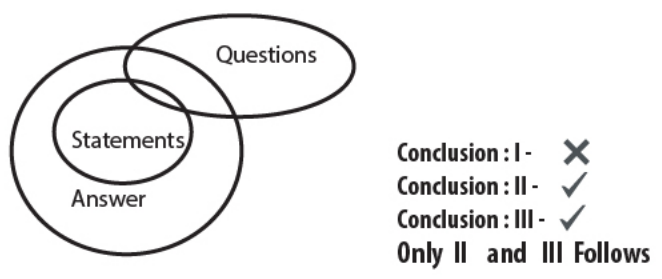
Two statements are given, followed by three conclusions numbered I, II and III. Assuming the statements to be true, even if they seem to be at variance with commonly known facts, decide which of the conclusions logically follow(s) from the statements.

Statements:

All statements are answers.

Some statements are questions.

Conclusions:

I. No question is a statement.

II. Some answers are statements.

III. Some questions are statements.

Answer & explanation+

Correct answer: option 4

Advertisement

Practise more on Verbal Reasoning

Chapter-wise mocks on the real NTA exam screen, with solutions and your rank. Your first mocks are free.

Start free mocks →

Advertisement

Next questions

  1. Match the following for an enterprise while making a cash flow statement: LIST 1 LIST 2 A) Increase in current assets I) Cash outflow B) In…Accountancy Part B · Cash Flow Statement
  2. On which basis Receipts and Payments account is prepared?Accountancy Part A · Accounts for Non Profit Organsiation
  3. In a plane electromagnetic wave, the magnetic field oscillates sinusoidally at a frequency of 2.0×10^10 Hz and amplitude 1.6×10^-7 T . The…Physics · Electromagnetic Waves
  4. Given below are two statements:Statement I: In a market system, the price of a good reflects, on an average, the society’s valuation of the…Economics · Micro Economics: Introduction
  5. A man and a woman, working together can do a work in 66 days. The ratio of their working efficiencies is 3 : 2. In how many days 6 men and…General Aptitude Test · Numerical Ability
  6. The average age of a man and his son is 55 years. The ratio of their ages is 7 : 4, respectively. What will be the ratio of their ages afte…General Aptitude Test · General Ability
  7. Select the most appropriate meaning of the given idiom. To make both ends meetEnglish · Grammar: Idioms
  8. Arrange the following events in the discovery of Penicillin in the order in which they happened:A. Fleming traced the effect to a chemical…Biology · Microbes in Human Welfare
  9. The number of students in Class XI in Science, Arts and Commerce streams of a school over a period of 4 years (2011 - 2014) has been depict…General Aptitude Test · Quantitative Reasoning
  10. From the given options, select the Figure of Speech (Poetic Device) used in the expression: The light of knowledgeEnglish · Figure of Speech