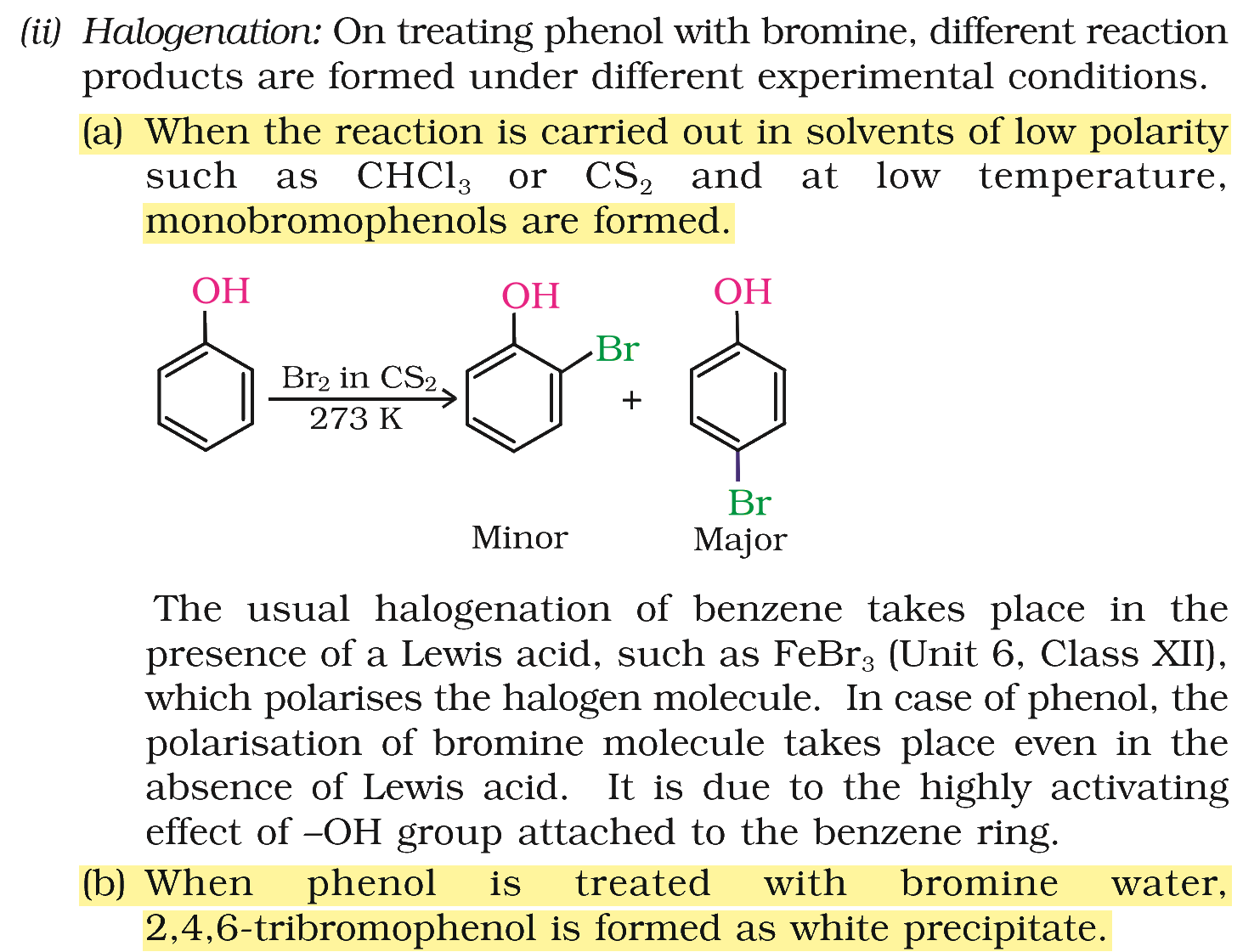
Phenol reacts with bromine in aqueous and non-aqueous media such as CS2, respectively to form following products :
Answer & explanation
Correct answer: option 3
The correct answer is Option (3) → 2,4,6-tribromophenol; 4-Bromophenol
The –OH group of phenol releases electrons into the ring by resonance. This activates the ring strongly and directs incoming groups to the ortho and para positions. How far the bromination goes depends on the solvent:
In bromine water, water polarises bromine and ionises some phenol to the more reactive phenoxide ion, so all three ortho and para positions are substituted; in CS2 or CHCl3 at low temperature bromine is hardly polarised, so only one bromine enters, mainly at the para position.
\( \displaystyle \ce{C6H5OH + 3Br2} \xrightarrow{\ce{H2O}} \ce{C6H2Br3OH + 3HBr} \)
\( \displaystyle \ce{C6H5OH + Br2} \xrightarrow{\ce{CS2},\ 273\ \mathrm{K}} \ce{BrC6H4OH + HBr}\quad\text{(4-bromophenol, major)} \)
NCERT (2026-27 edition):
Halogenation