
The following reaction is an example of
Answer & explanation
Correct answer: option 1
The correct answer is Option (1) → Cannizzaro reaction
Complete statement:
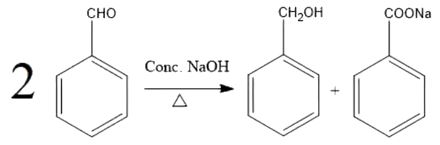
The given reaction is an example of the Cannizzaro reaction.
Reasoning:
Benzaldehyde (an aldehyde without an α-hydrogen atom) reacts with concentrated NaOH and undergoes disproportionation. In this process:
- One molecule of benzaldehyde is reduced to benzyl alcohol (–CH₂OH).
- Another molecule is oxidized to sodium benzoate (–COONa).
This simultaneous oxidation and reduction of the same aldehyde in a strong base is characteristic of the Cannizzaro reaction.
- Reactant: Benzaldehyde ($C_6H_5CHO$) is used. The carbon atom adjacent to the aldehyde group (the $\alpha$-carbon) is part of the benzene ring and has no attached hydrogens.
- Conditions: It reacts in the presence of a strong base, specifically Conc. NaOH, and heat ($\Delta$).
- Products: One molecule of benzaldehyde is reduced to an alcohol (Benzyl alcohol, $C_6H_5CH_2OH$), while the second molecule is oxidized to a carboxylic acid salt (Sodium benzoate, $C_6H_5COONa$).