Which one of the following is responsible for producing the large holes in "Swiss cheese"?
Answer & explanation
Correct answer: option 2
The correct answer is Option (2) → Propionibacterium sharmanii
Option (1) Saccharomyces cerevisiae — Incorrect. This is baker’s yeast, a fungus. It ferments the dough for bread and is also used to make ethanol. It is not used to make Swiss cheese.
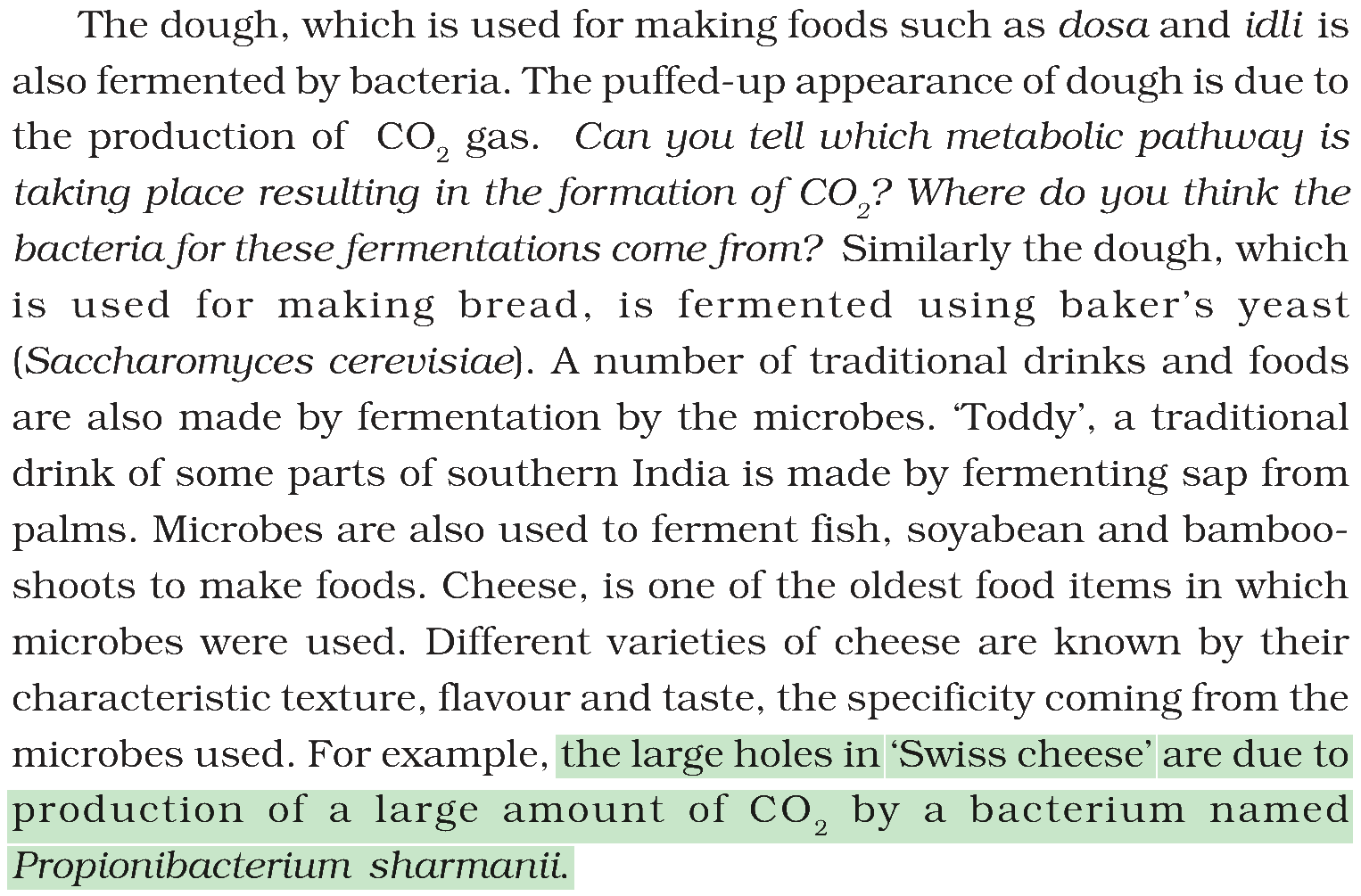
Option (2) Propionibacterium sharmanii — Correct. This bacterium produces a large amount of carbon dioxide while the cheese ripens. The gas is trapped inside the cheese and leaves the large holes of Swiss cheese.
Option (3) Lactobacillus — Incorrect. Lactobacillus is a lactic acid bacterium. It turns milk into curd by producing acid that clots the milk proteins. It does not make the holes.
Option (4) Trichoderma polysporum — Incorrect. This fungus produces cyclosporin A, which is used to suppress the immune system in organ-transplant patients. It has nothing to do with cheese.
Note: A similar question was also asked in CUET (UG) 2026 on 22-05-2026 (Slot 1), in CUET (UG) 2025 on 22-05-2025 (Slot 2), and in CUET (UG) 2023 on 10-06-2023 (Slot 3).
NCERT Extract:
Microbes in Household Products – “… Different varieties of cheese are known by their characteristic texture, flavour and taste, the specificity coming from the microbes used. For example, the large holes in ‘Swiss cheese’ are due to production of a large amount of CO2 by a bacterium named Propionibacterium sharmanii.”