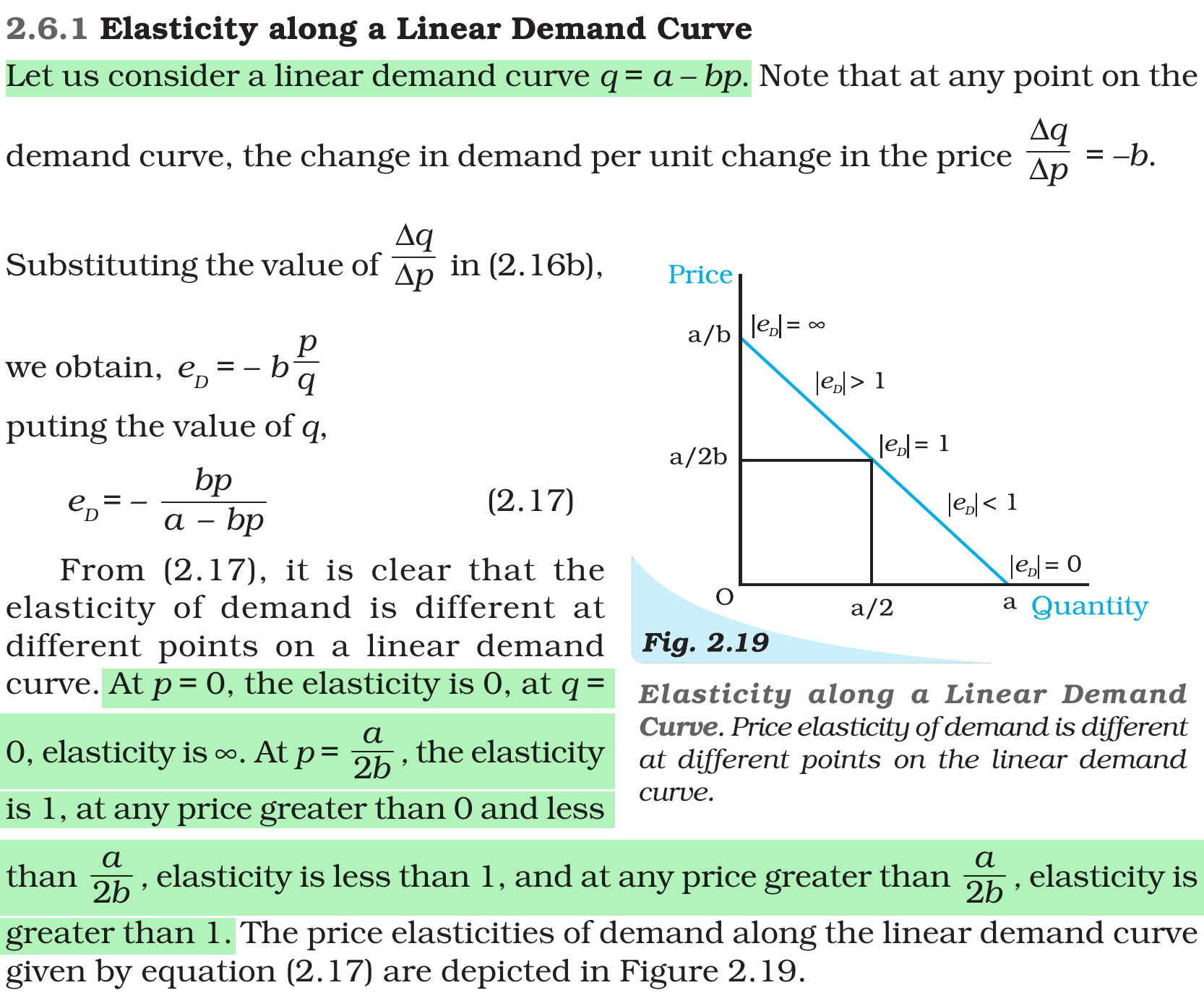
Let us consider a linear demand curve \( q = a - bp \). On the same demand curve, arrange the elasticity in ascending order.
(A) \( |e_D| = 1 \).
(B) \( |e_D| < 1 \).
(C) \( |e_D| > 1 \).
(D) \( |e_D| = 0 \).
Choose the correct answer from the options given below:
Answer & explanation
Correct answer: option 2
The correct answer is Option (2) → (D), (B), (A), (C)
On a straight-line demand curve, the price elasticity of demand (eD) is different at different points. It is the ratio \( \frac{bp}{a - bp} \), leaving out the minus sign. So it grows as the price rises.
(D) \( |e_D| = 0 \) — This is at p = 0, where the curve meets the quantity axis. The top of the ratio is zero.
(B) \( |e_D| \lt 1 \) — This holds at any price greater than 0 and less than \( \frac{a}{2b} \), the lower half of the curve.
(A) \( |e_D| = 1 \) — This is at p = \( \frac{a}{2b} \), the middle of the curve.
(C) \( |e_D| \gt 1 \) — This holds at any price greater than \( \frac{a}{2b} \), the upper half of the curve.
NCERT (2026-27): Introductory Microeconomics — Chapter 2: Theory of Consumer Behaviour
|