Identify the correct statements:
A. Lord William Bentinck abolished Sati in 1839.
B. Kunwar Singh was a leader from Arrah, Bihar.
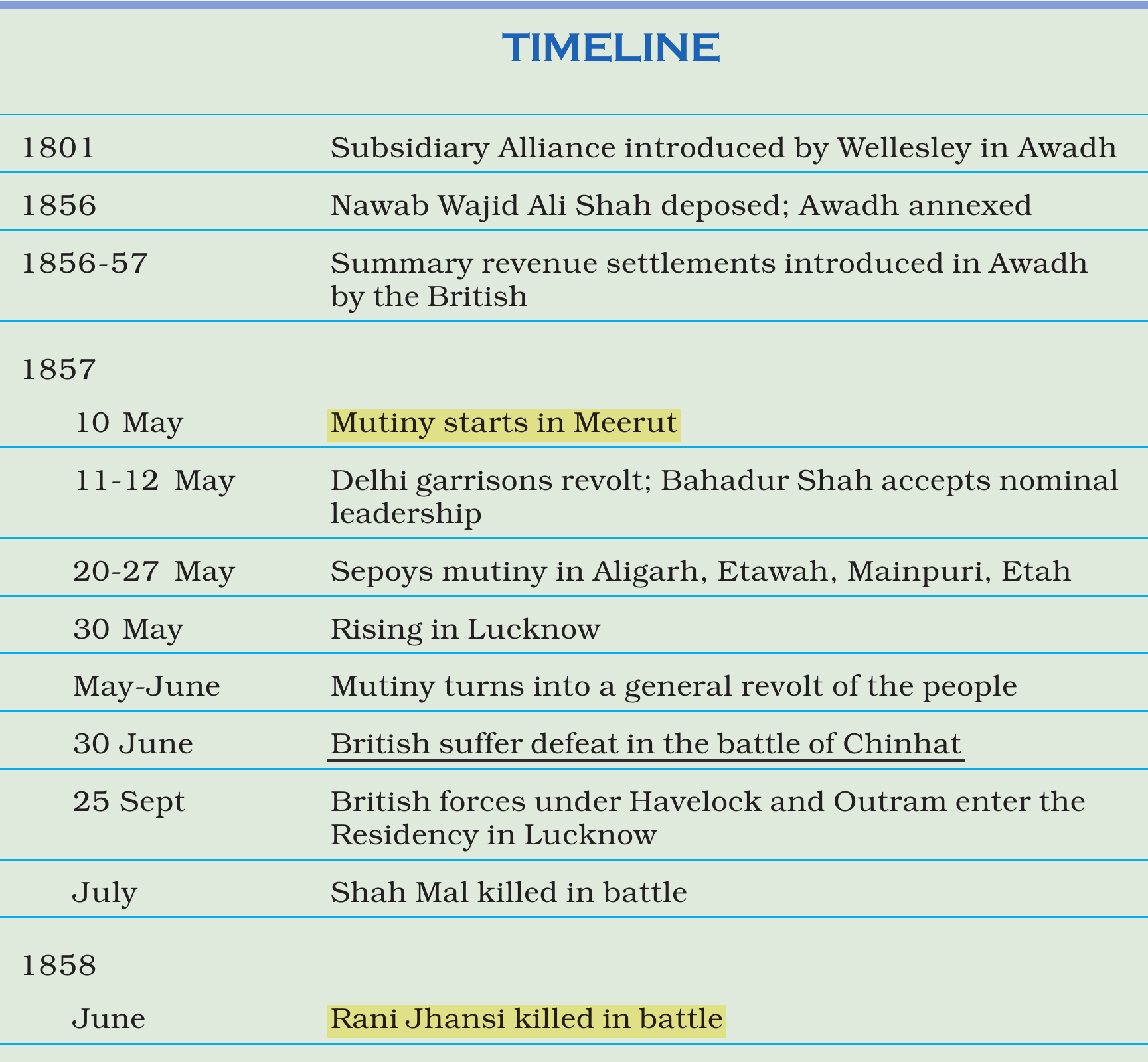
C. Rani Lakshmi Bai was killed in June 1858.
D. The Revolt of 1857 started from Meerut.
E. British were victorious in the Battle of Chinhat.
Choose the correct answer from the options given below:
Answer & explanation
Correct answer: option 3
The correct answer is Option (3) → B, C, D only
A. Lord William Bentinck abolished Sati in 1839. Incorrect. From the late 1820s, under Governor General Lord William Bentinck, the British established laws to abolish customs like sati in 1829, not 1839.
B. Kunwar Singh was a leader from Arrah, Bihar. Correct. Kunwar Singh, a local zamindar in Arrah in Bihar, was pushed by popular pressure to lead the uprising.
C. Rani Lakshmi Bai was killed in June 1858. Correct. The chapter’s timeline gives June 1858: Rani Jhansi killed in battle.
D. The Revolt of 1857 started from Meerut. Correct. Late in the afternoon of 10 May 1857, the sepoys in the cantonment of Meerut broke out in mutiny, and the revolt spread from there.
E. British were victorious in the Battle of Chinhat. Incorrect. In the Battle of Chinhat (30 June 1857) the British forces under Henry Lawrence were defeated.
NCERT (2026-27): “1.5 Why did people believe in the rumours? … The rumours in 1857 begin to make sense when seen in the context of the policies the British pursued from the late 1820s. As you know, from that time, under the leadership of Governor General Lord William Bentinck, the British adopted policies aimed at ‘reforming’ Indian society by introducing Western education, Western ideas and Western institutions. With the cooperation of sections of Indian society they set up English-medium schools, colleges and universities which taught Western sciences and the liberal arts. The British established laws to abolish customs like sati (1829) and to permit the remarriage of Hindu widows.… 1.3 Leaders and followers … Elsewhere, similar scenes were enacted though on a minor scale. In Kanpur, the sepoys and the people of the town gave Nana Sahib, the successor to Peshwa Baji Rao II, no choice save to join the revolt as their leader. In Jhansi, the rani was forced by the popular pressure around her to assume the leadership of the uprising. So was Kunwar Singh, a local zamindar in Arrah in Bihar. In Awadh, where the displacement of the popular Nawab Wajid Ali Shah and the annexation of the state were still very fresh in the memory of the people, the populace in Lucknow celebrated the fall of British rule by hailing Birjis Qadr, the young son of the Nawab, as their leader.…”
|