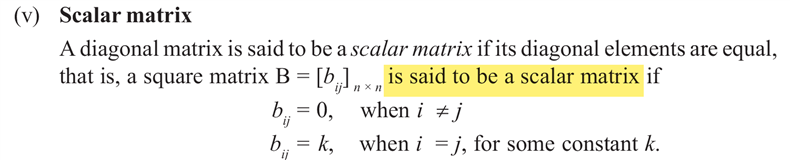
A square matrix \(B=[b_{ij}]_{n\times n}\) where
\(b_{ij}=0\) when \(i \ne j\)
\(b_{ij}=k\) when \(i=j\) for some constant k is called:
Answer & explanation
Correct answer: option 3
The correct answer is Option (3) → Scalar matrix
Every entry off the main diagonal is 0, so B is a diagonal matrix. In addition, every diagonal entry is the same constant k. A diagonal matrix whose diagonal entries are all equal is called a scalar matrix.
For example, with n = 3 and k = 5:
\( \displaystyle B = \begin{bmatrix}5 & 0 & 0\\ 0 & 5 & 0\\ 0 & 0 & 5\end{bmatrix} = 5I \)
So a scalar matrix is always kI, a constant times the identity matrix.
Why the other options are incorrect
Option (1) Skew-symmetric matrix — Incorrect. A skew-symmetric matrix has every diagonal entry 0, which happens here only when k = 0.
Option (2) Identity matrix — Incorrect. The identity matrix is only the special case k = 1.
Option (4) Null matrix — Incorrect. The null matrix is only the special case k = 0.
NCERT (2026-27 edition):
Types of Matrices