
CUETMOCK
  • Pricing
  • Mentors
Log inStart freeStart free mocks→

First test, then trust

Try a free CUET mock test.

Join 5,00,000+ students who rehearsed exam day on the exact NTA screen before sitting CUET. On the web and on Android.

Start free mocks →Get the Android app
CUETMOCK

India's #1 CUET Mock Test Platform. Original NCERT-based questions on the exact NTA exam screen — trusted by 5,00,000+ students since CUET 2022.

Get it onGoogle PlayScan to download the CUETMOCK app

Mock tests

  • CUET mock test series
  • Commerce mocks
  • Humanities (Arts) mocks
  • Science mocks
  • Languages & GAT mocks
  • Free practice questions
  • Pricing

Resources

  • CUET exam guide
  • CUET syllabus
  • Universities accepting CUET
  • Expert blogs
  • News & notifications
  • Webinars & counselling
  • CUET score calculator
  • How we estimate your rank
  • FAQs

Company

  • About us
  • Our leadership & team
  • Our toppers
  • Mentors
  • For schools
  • Contact us
  • Terms
  • Privacy
  • Refund policy

Talk to us

+91 7696 6630 56info@cuetmock.comWhatsApp us

Our other platforms

  • JEE Mock — For IIT-JEE aspirants
  • NEET Mock — For NEET aspirants

Newsletter

Exam updates, study material and offers — no spam.

© 2026 NYC Ventures Pvt. Ltd.

701-702, Royal Business Park, Zirakpur, Punjab - 140603

  • Terms of use
  • Privacy policy
  • Refund policy
  • Contact us

iCUETMOCK is an independent preparation platform, not affiliated with the National Testing Agency (NTA). Always check exam details on the official NTA website.

  • Home
  • Mock tests
  • CUET guide
  • Pricing
  • Log in
Home/Practice questions/Biology
BiologyOrganisms and Populations

Observe the graph and choose the correct option from the following:
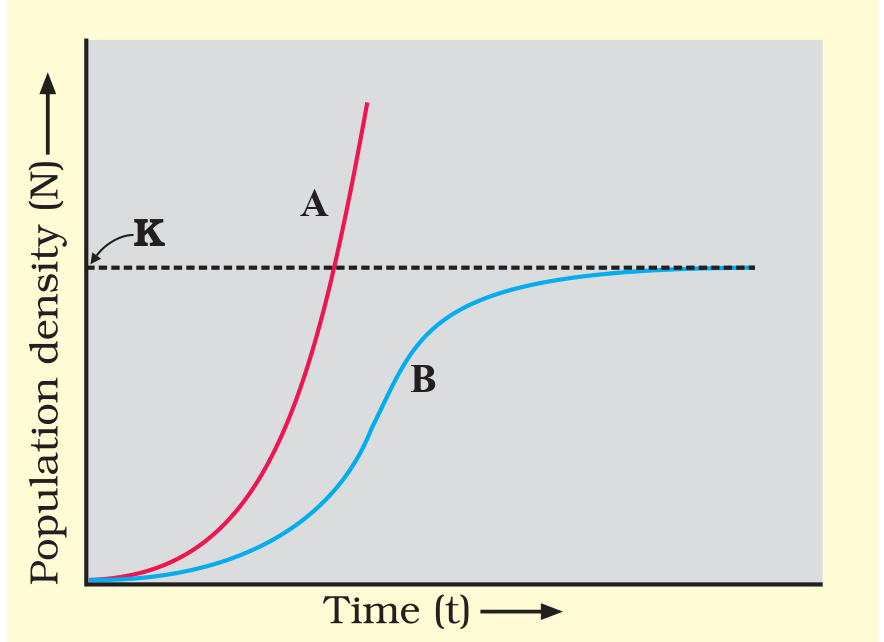
Observe the graph and choose the correct option from the following:

Population growth curves

Answer & explanation+

Correct answer: option 1

The correct answer is Option (1) → A = \(\frac{dN}{dt}\) = rN; B = \(\frac{dN}{dt}\) = rN(\(\frac{K-N}{K}\))

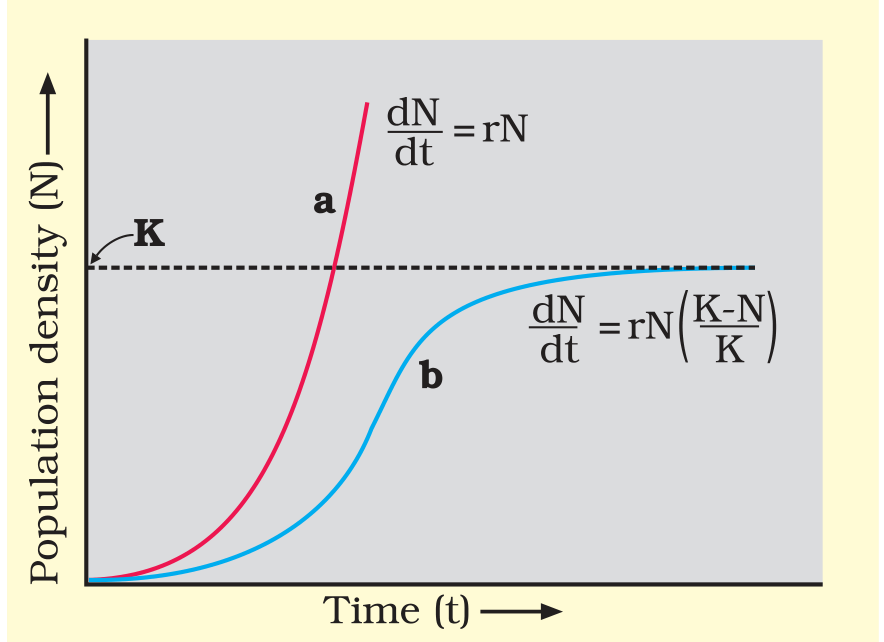
A population grows in one of two ways. When resources are unlimited it grows in an exponential (geometric) way: \(\displaystyle\frac{dN}{dt} = rN\), and the plot of N against time is a J-shaped curve. When resources are limited the growth slows and stops at the carrying capacity (K). This is logistic growth, \(\displaystyle\frac{dN}{dt} = rN\left(\frac{K-N}{K}\right)\), and the plot is a sigmoid curve. In the graph, curve A keeps rising (curve a of the book’s Figure 11.3) and curve B levels off at K (curve b).

Option (1) A = \(\frac{dN}{dt}\) = rN; B = \(\frac{dN}{dt}\) = rN(\(\frac{K-N}{K}\)) — Correct. A is J-shaped, so it is exponential growth, rN. B flattens at K, so it is logistic growth. As N comes close to K, the term (K−N)/K becomes nearly zero, and growth almost stops.

Option (2) A = \(\frac{dN}{dt}\) = rN; B = \(\frac{dN}{dt}\) = rN(\(\frac{K}{K-N}\)) — Incorrect. A is right, but B is wrong. In K/(K−N) the value gets larger as N comes close to K, so growth would speed up near the carrying capacity instead of stopping.

Option (3) A = \(\frac{dN}{dt}\) = rN(\(\frac{K-N}{K}\)); B = \(\frac{dN}{dt}\) = rN. — Incorrect. This swaps the two curves. A J-shaped curve never levels off, so it cannot carry the (K−N)/K term, and the sigmoid curve B cannot be the unlimited growth rN.

Option (4) A = \(\frac{dN}{dt}\) = rN(\(\frac{K-N}{K}\)); B = \(\frac{dN}{dt}\) = rN(\(\frac{K}{K-N}\)) — Incorrect. Both parts are wrong. A is not logistic, and K/(K−N) does not describe any growth that levels off at K.

Note: Swap the a and b of Figure 11.3 for A and B, and the book’s graph turns into a question. Learn each curve with its own equation, and a relabelled figure will not slow you down.

NCERT Extract:
Population Growth – “… The above equation describes the exponential or geometric growth pattern of a population (Figure 11.3) and results in a J-shaped curve when we plot N in relation to time.”
Population Growth – “A population growing in a habitat with limited resources show initially a lag phase, followed by phases of acceleration and deceleration and finally an asymptote, when the population density reaches the carrying capacity. A plot of N in relation to time (t) results in a sigmoid curve. This type of population growth is called Verhulst-Pearl Logistic Growth (Figure 11.3) and is described by the following equation:
\(\displaystyle\frac{dN}{dt} = rN\left(\frac{K-N}{K}\right)\)
Where N = Population density at time t
r = Intrinsic rate of natural increase
K = Carrying capacity”
Textbook figure

Figure 11.3 Population growth curve a when responses are not limiting the growth, plot is exponential, b when responses are limiting the growth, plot is logistic, K is carrying capacity

Advertisement

Practise more on Organisms and Populations

Chapter-wise mocks on the real NTA exam screen, with solutions and your rank. Your first mocks are free.

Start free mocks →

Advertisement

Next questions

  1. Select the most appropriate synonym of the underlined word in the given sentence. Isn't knowledge supposed to make life sweeter and happier?English · Synonyms
  2. ‘Rule of Law’ in our Constitution have been borrowed from which of the following country?Legal Studies · Judiciary
  3. 'मधुशाला' काव्य कृति के रचनाकार हैं -Hindi · हिंदी साहित्य (रचना, रचनाकार और विधाएँ)
  4. Choose the option that is the correct passive form of the sentence. She ate the last slice of pizza.English · Grammar: Active Passive Voice
  5. Match List-I with List-IIList-I(Name of leader)List-II(Their achievements/movements)(A)Ram Manohar Lohia(I)Contested as independent candida…Political Science · Politics in India Since Independence: Challenges to and Restoration of the Congress System
  6. The expression (cos^6θ + sin^6θ - 1) (tan^2θ +cot^2θ +2) +3 is equal to :General Aptitude Test · Quantitative Reasoning
  7. Factors that do not affect Hardy-Weinberg equilibrium are:(A). Genetic drift(B). Mitosis(C). Genetic recombination and natural selection(D)…Biology · Evolution
  8. Which of the following is a covalent solid?Chemistry · Physical: Solid State
  9. Which Indian state is held as a success story in the efficient implementation of milk cooperatives?Economics · Indian Economic Development: Rural Development
  10. कवि को किसने उदार बनाया है?Hindi · Comprehension - (Poetry / Literary)