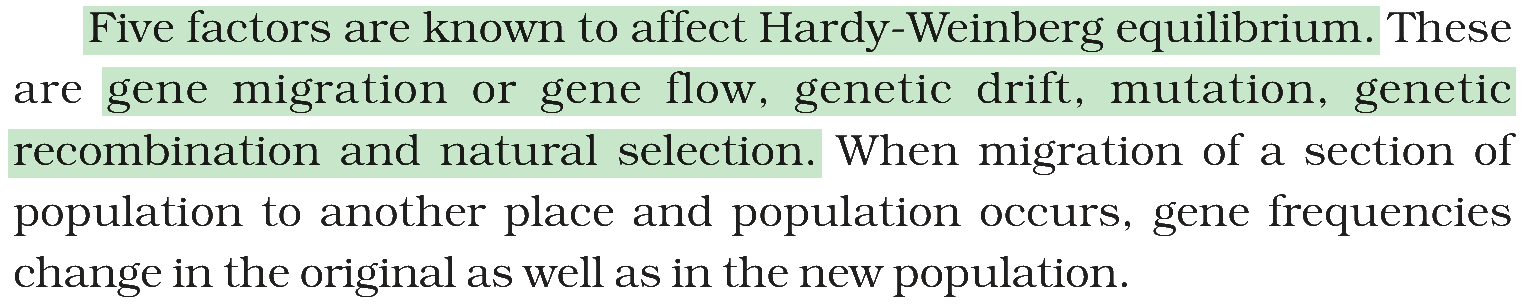
Factors that do not affect Hardy-Weinberg equilibrium are:
(A). Genetic drift
(B). Mitosis
(C). Genetic recombination and natural selection
(D). Pleiotropy
Choose the correct answer from the options given below:
Answer & explanation
Correct answer: option 3
The correct answer is Option (3) → (B) and (D) only
The Hardy-Weinberg principle says that allele frequencies in a population stay constant from generation to generation. This is genetic equilibrium. A factor affects it only if it changes the allele frequencies of the population.
(A) Genetic drift Not included. Genetic drift is a change in allele frequencies by chance, strongest in small populations. So it does affect the equilibrium.
(B) Mitosis Included. Mitosis gives two daughter cells with the same chromosomes as the parent cell. It forms no new alleles and changes no frequencies, so it does not affect the equilibrium.
(C) Genetic recombination and natural selection Not included. Recombination forms new combinations of alleles, and natural selection makes useful alleles more common. Both change the allele frequencies.
(D) Pleiotropy Included. Pleiotropy means that one gene shows its effect on several traits. It describes how a gene acts in one individual; it does not change allele frequencies in the population.
NCERT Extract:
Hardy-Weinberg Principle – …