
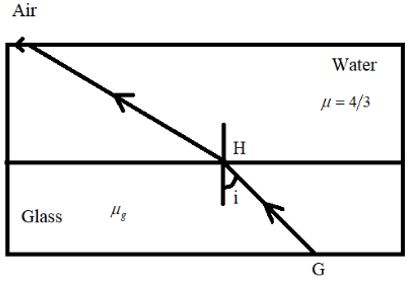
A ray of light travels as shown in the figure. After passing from glass into water, the ray grazes along the water-air interface. The refractive index \( \mu_g \) of glass in terms of i is
Answer & explanation
Correct answer: option 1
The correct answer is Option (1) → \( \frac{1}{\sin i} \)
At each surface the ray obeys Snell’s law, \( n_1\sin i=n_2\sin r \). The glass–water and water–air surfaces are parallel. So the angle of refraction in water at H is also the angle of incidence at the water–air surface.
From the figure, the ray from G meets the glass–water surface at H at an angle \( i \). Let \( r \) be its angle in water. At H:
\( \mu_g\sin i=\mu_w\sin r \)
At the water–air surface the ray emerges grazing, so its angle in air is \( 90^\circ \):
\( \begin{aligned} \mu_w\sin r &= 1\times\sin90^\circ \\ &= 1 \end{aligned} \)
From the above, \( \mu_g\sin i=1 \). Hence:
\( \displaystyle \mu_g=\frac{1}{\sin i} \)
The value \( \mu_w=4/3 \) is not needed, because \( \mu\sin\theta \) has the same value in every layer bounded by parallel surfaces.