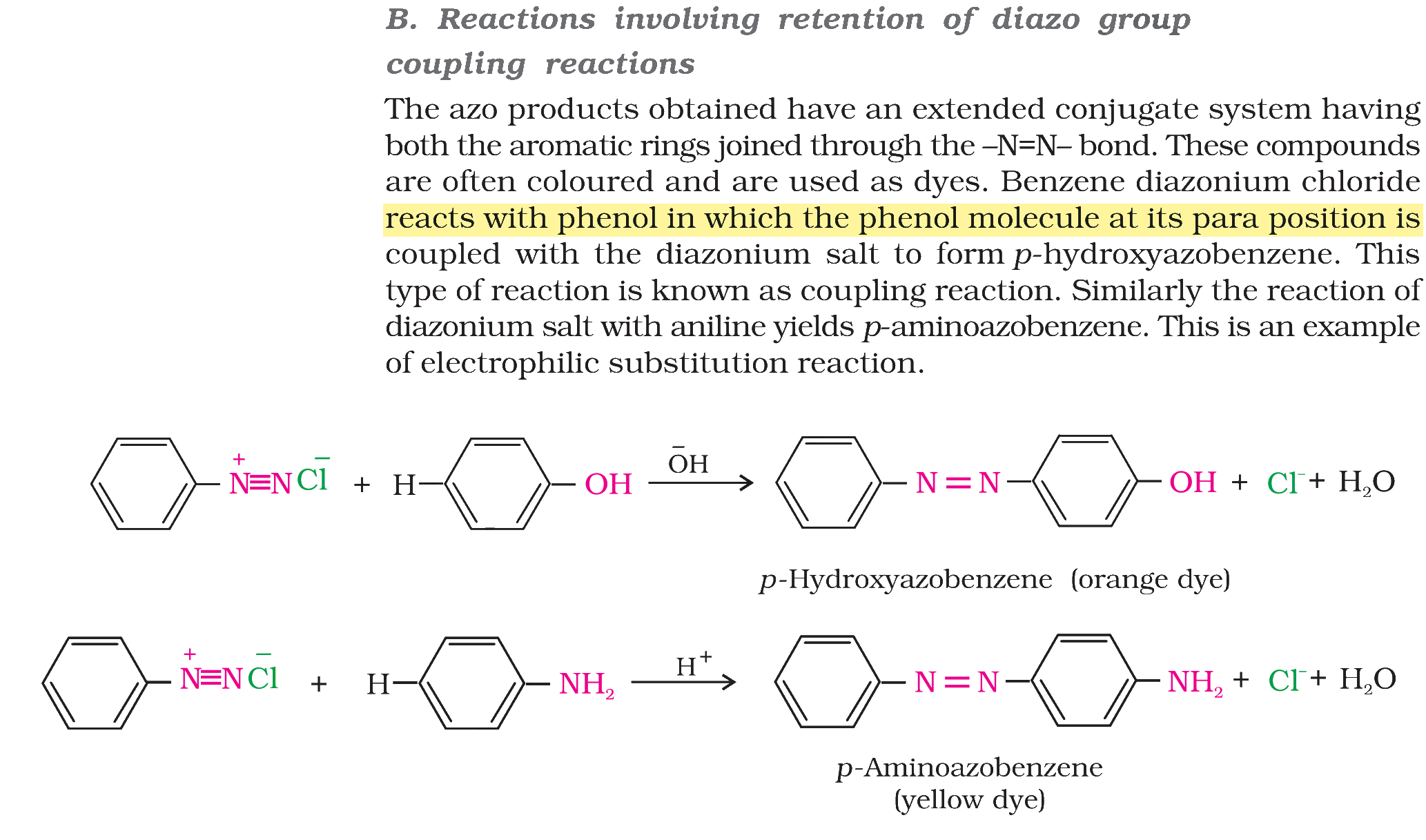
Coupling of benzene diazonium chloride with phenol yields colored compounds called azo dyes. The reaction requires
Answer & explanation
Correct answer: option 2
The correct answer is Option (2) → alkaline medium
In a coupling reaction the benzene diazonium ion acts as a weak electrophile and attacks the para position of a strongly activated ring.
The reaction is carried out in a mildly alkaline medium (pH about 9–10). In alkali, phenol is converted into the phenoxide ion, whose negatively charged oxygen activates the ring far more than –OH does, so the weak electrophile can attack it:
\( \displaystyle \ce{C6H5OH + OH- -> C6H5O- + H2O} \)
Why the other options are incorrect
Option (1) acidic medium — Incorrect. A mildly acidic medium is used for coupling with aniline, giving p-aminoazobenzene (yellow dye). With phenol, acid keeps it un-ionised and it is not reactive enough.
Option (3) neutral medium — Incorrect. In neutral solution very little phenoxide ion is present, so coupling is slow.
Option (4) catalyst — Incorrect. No catalyst is needed; the diazonium ion is itself the electrophile once the ring is activated by the phenoxide oxygen.
NCERT (2026-27 edition):
Reactions Involving Retention of Diazo Group