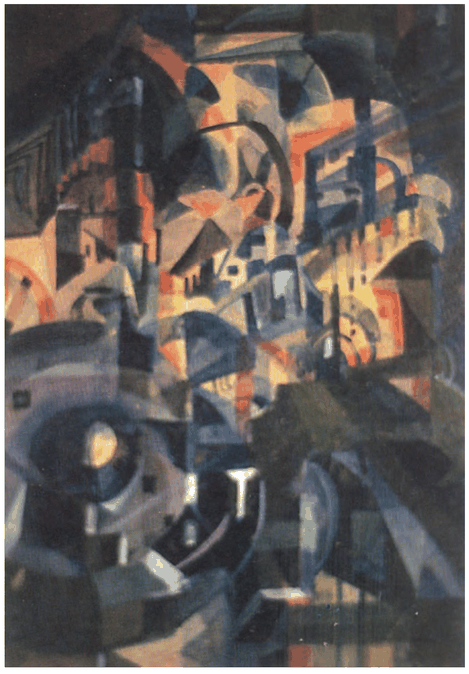
Who painted A Cubist City (1925)?
Answer & explanation
Correct answer: option 2
The correct answer is Option (2) → Gaganendranath Tagore
Option (1) Nandalal Bose — Incorrect. He joined Kala Bhavana in 1921–1922 after training under Abanindranath Tagore.
Option (2) Gaganendranath Tagore — Correct. He painted A Cubist City in 1925, using the language of Cubism in a style of his own.
Option (3) Rabindranath Tagore — Incorrect. He made doodles out of crossed-out words, as in Doodle (1920).
Option (4) Abanindranath Tagore — Incorrect. He nurtured the Bengal School of Art with E. B. Havell.
Note: This topic was not named in the CUET 2026 syllabus, but it was part of the NCERT chapter. In 2025 and 2026, NTA also asked questions on topics in NCERT that the CUET syllabus did not name. So our mocks have questions from every part of the NCERT chapter, to give you enough practice. Read the whole chapter, not only the sub-topics named in the syllabus.
NCERT (2026-27): “Introduction to Modernism in India …Gaganendranath Tagore used the language of Cubism to create a unique style of his own. His paintings of mysterious halls and rooms were made with vertical, horizontal and diagonal lines, which were quite different from the Cubist style of famous artist Pablo Picasso, who invented the style using geometrical facets.”
Gaganendranath Tagore, A Cubist City, 1925. Victoria Memorial Hall, Kolkata, India |