Cryopreservation technique used for the conservation of threatened animals and plants is:
Answer & explanation
Correct answer: option 4
The correct answer is Option (4) → Ex situ conservation approach
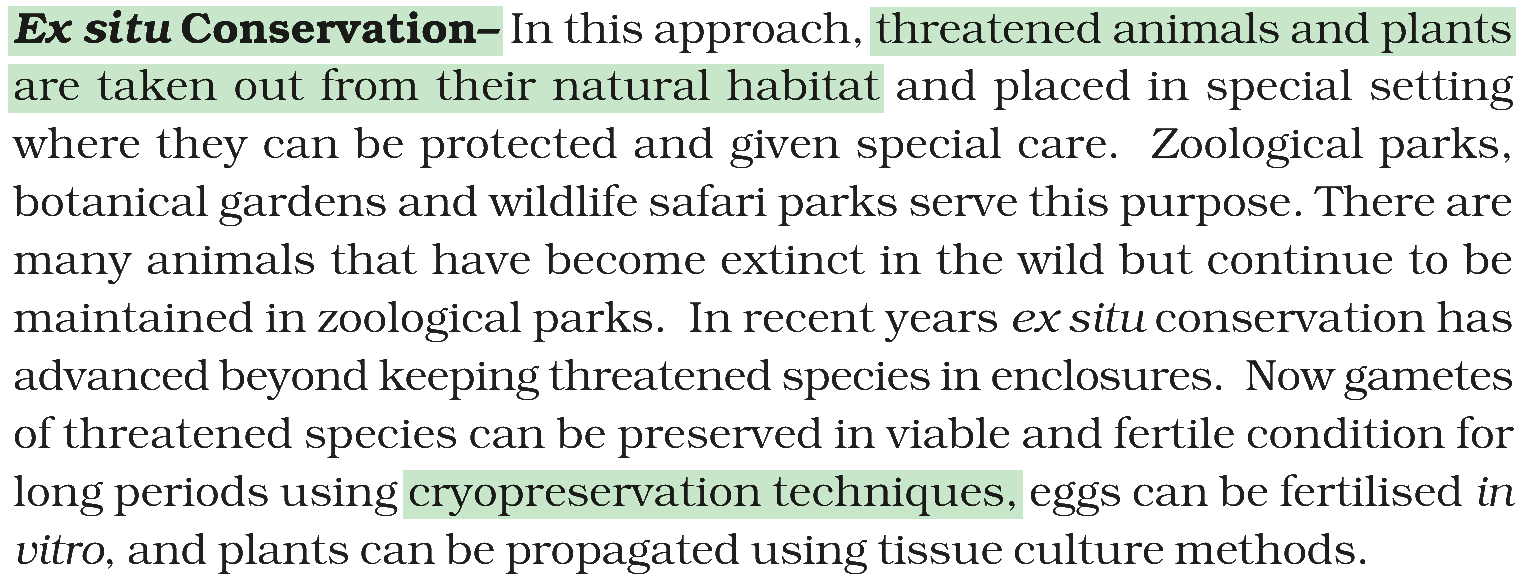
Cryopreservation means keeping living material, such as gametes, frozen at very low temperatures, so that it stays viable and fertile for long periods.
Option (1) Narrowly utilitarian approach — Incorrect. This is not a method of conservation but a reason for conserving biodiversity. It says that humans get direct economic benefits from nature, such as food, fibre, firewood and medicines.
Option (2) In situ conservation approach — Incorrect. In situ (on site) conservation protects species in their natural habitat, as in biosphere reserves, national parks, sanctuaries and sacred groves. Frozen gametes are kept far away from the habitat.
Option (3) In vivo approach of conservation — Incorrect. “In vivo” means inside a living body. Cryopreserved gametes are kept outside the body, in a frozen state, so this name does not fit them. Conservation is divided into in situ and ex situ approaches.
Option (4) Ex situ conservation approach — Correct. Ex situ (off site) conservation takes threatened species out of their natural habitat and protects them elsewhere. Cryopreservation of gametes is one of its modern methods, along with zoos, botanical gardens, seed banks and tissue culture.
NCERT Extract:
How Do We Conserve Biodiversity? – …