
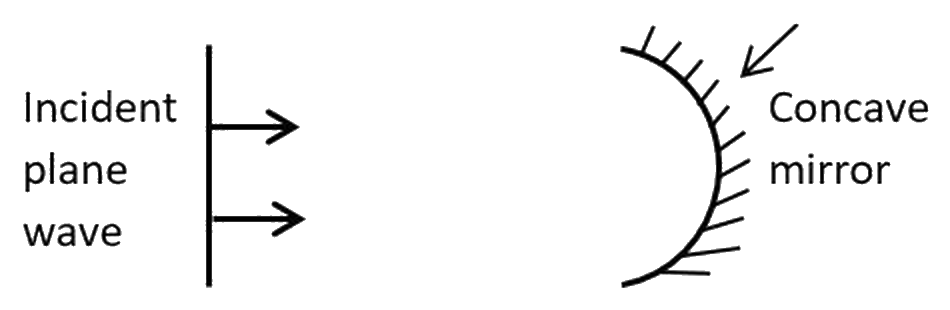
A plane wave is incident on a concave mirror of radius R. The shape of the reflected wavefront will be
Answer & explanation
Correct answer: option 3
The correct answer is Option (3) → converging spherical
A wavefront is perpendicular to the rays. The rays of an incident plane wave are parallel to the axis of the mirror, and after reflection from a concave mirror all of them pass through the focus, which is at a distance \( f = R/2 \) from the mirror.
So the reflected rays converge to a point, and the reflected wavefront, which is perpendicular to them, is a spherical surface centred at the focus and moving towards it. It is a converging spherical wavefront.
Why the other options are incorrect
Option (1) diverging spherical — Incorrect. A diverging spherical wavefront is produced by a convex mirror, whose reflected rays appear to come from a point behind it.
Option (2) plane wavefront — Incorrect. A plane wavefront is reflected as a plane wavefront only by a plane mirror.
Option (4) cylindrical — Incorrect. A spherical mirror sends all the rays to one point; a cylindrical wavefront would need a line focus, as from a cylindrical mirror.
NCERT (2026-27):
Reflection of a Plane Wave by a Plane Surface – “… In Fig. 10.7(c) a plane wave is incident on a concave mirror and on reflection we have a spherical wave converging to the focal point F.”