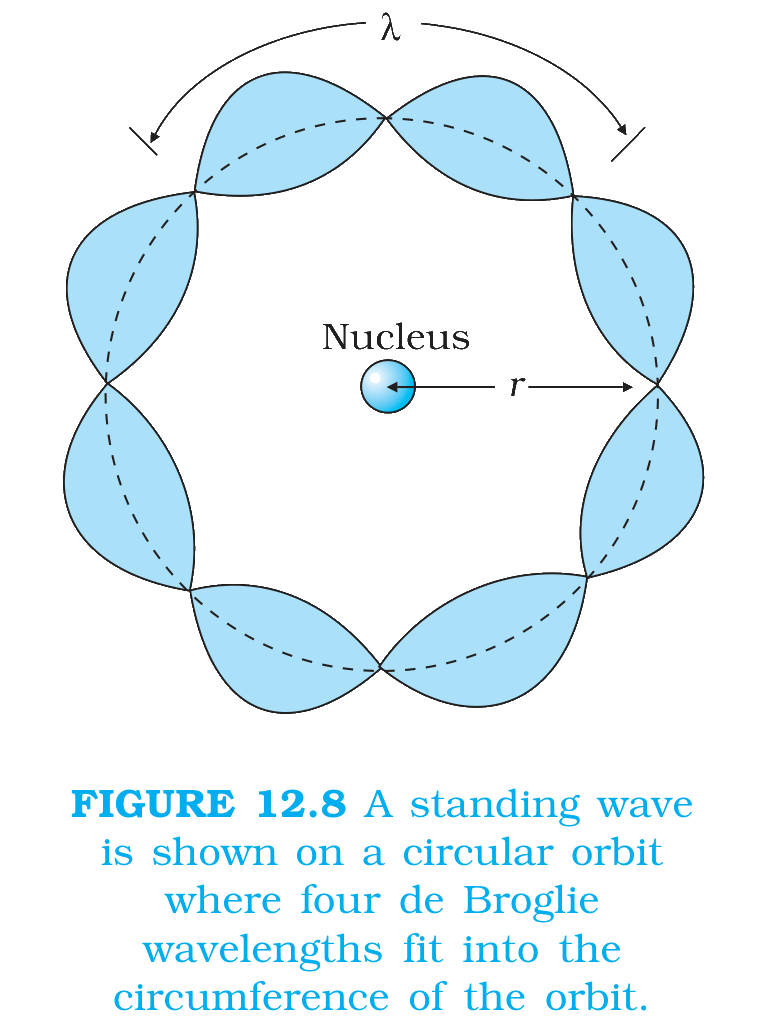
Four de Broglie wavelengths of the electron fit into the circumference of an orbit in a hydrogen atom. The de Broglie wavelength is \(1.33\times10^{-9}\ \mathrm{m}\). The radius of the orbit is
Answer & explanation
Correct answer: option 4
The correct answer is Option (4) → \(8.5\times10^{-10}\ \mathrm{m}\)
De Broglie treated the orbiting electron as a standing wave. Four wavelengths round the orbit means the circumference equals \( 4\lambda \).
\( 2\pi r=4\lambda \)
\( \begin{aligned} r &= \frac{4\lambda}{2\pi} \\ &= \frac{4\times1.33\times10^{-9}}{2\times3.14} \\ &= 8.5\times10^{-10}\ \mathrm{m} \end{aligned} \)
From the above, the radius of the orbit is about \( 8.5\times10^{-10}\ \mathrm{m} \). This is the \( n=4 \) orbit, 16 times the ground-state radius.
NCERT (2026-27):
De Broglie’s Explanation of Bohr’s Second Postulate of Quantisation – “… Figure 12.8 illustrates a standing particle wave on a circular orbit for n = 4, i.e., 2πrn = 4λ, where λ is the de Broglie wavelength of the electron moving in nth orbit.”