
The figure shows (a) a pure solvent and (b) a solution of a non-volatile solute in the same solvent, each in a closed vessel at the same temperature.
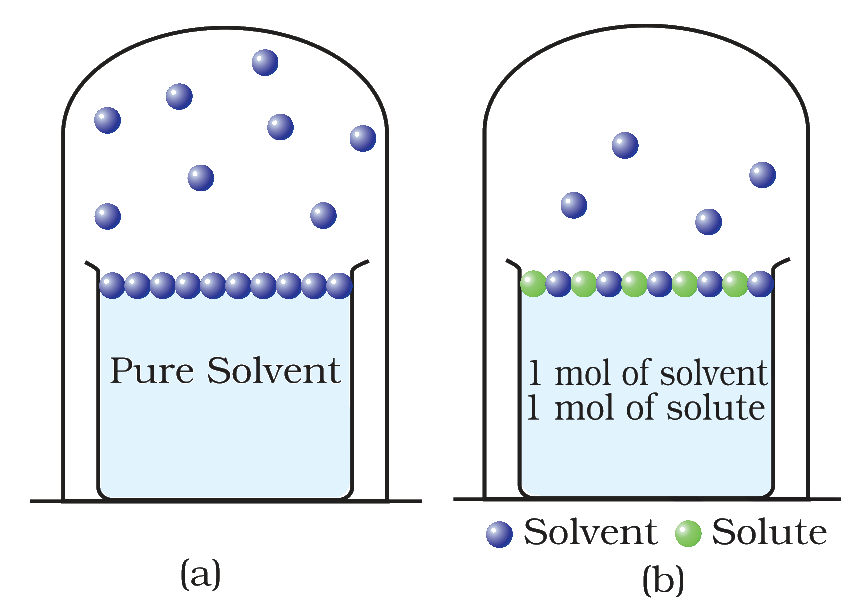
The vapour pressure of the pure solvent in (a) is p0. If the solution in (b) obeys Raoult’s law, what is its vapour pressure?
Answer & explanation
Correct answer: option 4
The correct answer is Option (4) → p0/2
The solute is non-volatile, so the vapour pressure of the solution comes from the solvent alone. By Raoult’s law it is the mole fraction of the solvent times the vapour pressure of the pure solvent. The figure gives the composition of solution (b): 1 mol of solvent and 1 mol of solute.
Mole fraction of the solvent
\( \displaystyle x_1 = \frac{1}{1 + 1} = 0.5 \)
Vapour pressure of the solution
\( \displaystyle p_1 = x_1\,p^0 = 0.5\,p^0 = \frac{p^0}{2} \)
NCERT (2026-27 edition):
1.4.3 Vapour Pressure of Solutions of Solids in Liquids – “If a non-volatile solute is added to a solvent to give a solution [Fig. 1.4.(b)], the vapour pressure of the solution is solely from the solvent alone. This vapour pressure of the solution at a given temperature is found to be lower than the vapour pressure of the pure solvent at the same temperature.”
“…Then according to Raoult’s law p1 ∝ x1 and p1 = x1 p10 (1.20) The proportionality constant is equal to the vapour pressure of pure solvent, p10.”
Fig. 1.4: Decrease in the vapour pressure of the solvent on account of the presence of solute in the solvent