
Consider the following sequence of reactions:
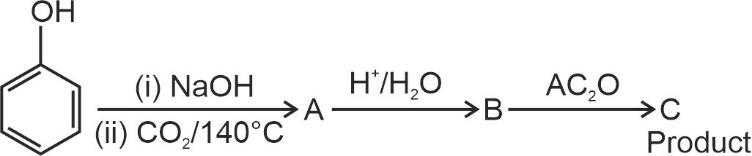
The final Product ‘C’ is
Answer & explanation
Correct answer: option 3
The correct answer is Option (3) → Aspirin
Phenol → A (Kolbe’s reaction): phenol with NaOH gives sodium phenoxide, which reacts with \( \ce{CO2} \) under pressure at about 400 K (140°C) to give sodium salicylate (A).
\( \ce{C6H5ONa + CO2} \xrightarrow{\text{400 K, 4-7 atm}} \text{o-}\ce{HOC6H4COONa} \)
A → B: acidification (\( \ce{H^{+}} \)/\( \ce{H2O} \)) gives salicylic acid, 2-hydroxybenzoic acid (B).
\( \text{o-}\ce{HOC6H4COONa + H+ -> } \text{o-}\ce{HOC6H4COOH + Na+} \)
B → C: acetic anhydride acetylates the phenolic –OH group, giving acetylsalicylic acid, i.e. aspirin (C):
\( \ce{HOC6H4COOH + (CH3CO)2O} \xrightarrow{\ce{H+}} \ce{CH3COOC6H4COOH + CH3COOH} \)
Why the other options are incorrect
Option (1) Salicylic acid — Incorrect. This is the intermediate B; acetic anhydride then converts it further.
Option (2) Salicylaldehyde — Incorrect. It is made from phenol by the Reimer–Tiemann reaction (\( \ce{CHCl3} \)/NaOH), not with \( \ce{CO2} \).
Option (4) Ethyl salicylate — Incorrect. An ester of the –COOH group with ethanol; acetic anhydride acylates the –OH group instead and supplies no ethyl group.