Read the passage and answer the questions:
Constitution: Real Minorities are the Masses of this Country
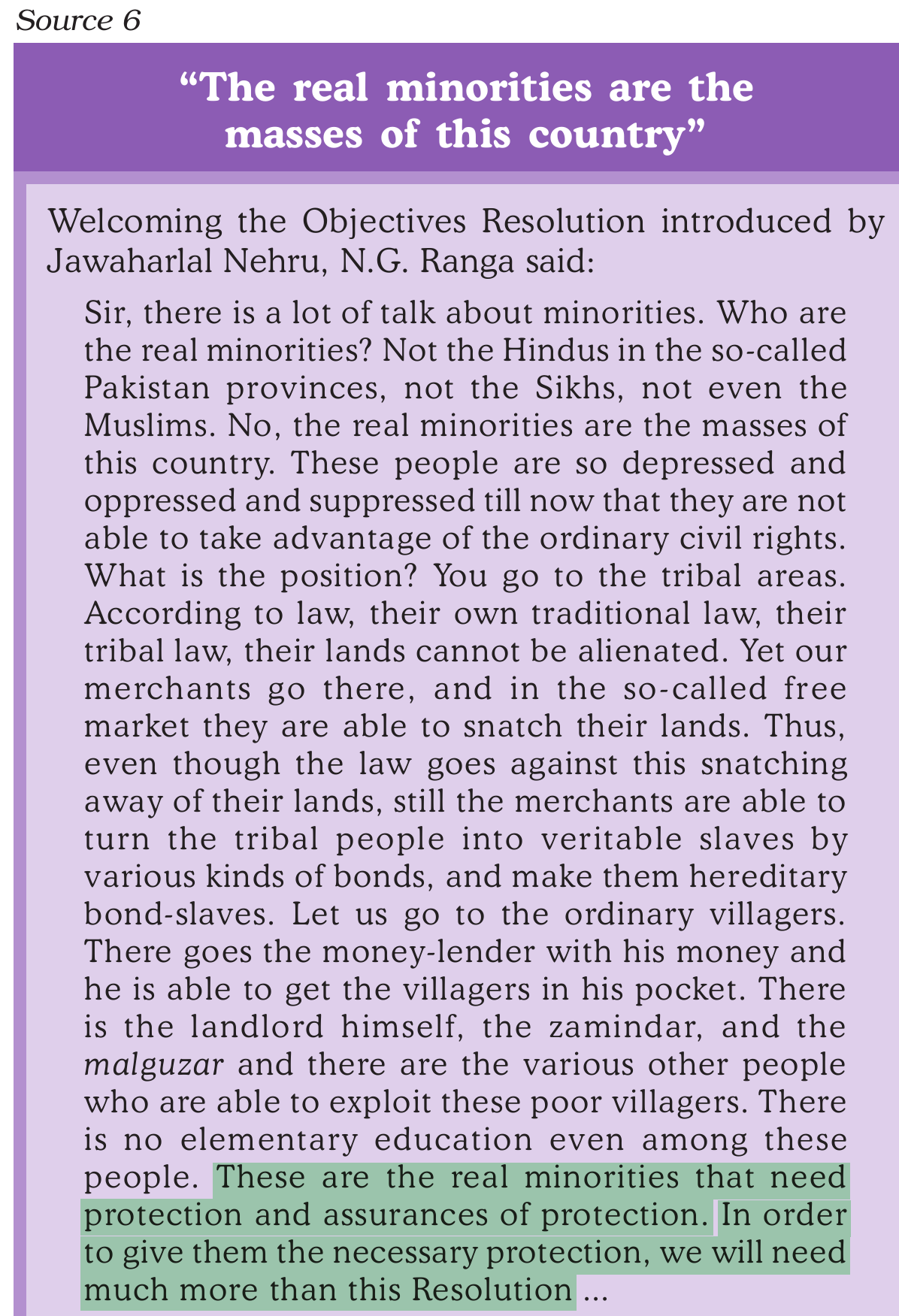
Welcoming the Objectives Resolution introduced by Jawaharlal Nehru, N.G. Ranga said: Sir, there is a lot of talk about minorities. Who are the real minorities? Not the Hindus in the so-called Pakistan provinces, not the Sikhs, not even the Muslims. No, the real minorities are the masses of this country. These people are so depressed and oppressed and suppressed till now that they are not able to take advantage of the ordinary civil rights. What is the position? You go to the tribal areas. According to law, their own traditional law, their tribal law, their lands cannot be alienated. Yet our merchants go there, and in the so-called free market they are able to snatch their lands. Thus, even though the law goes against this snatching away of their lands, still the merchants are able to turn the tribal people into veritable slaves by various kinds of bonds, and make them hereditary bond- slaves. Let us go to the ordinary villagers. There goes the money-lender with his money and he is able to get the villagers in his pocket. There is the landlord himself, the zamindar, and the malguzar and there are the various other people who are able to exploit these poor villagers. There is no elementary education even among these people. These are the real minorities that need protection and assurances of protection. In order to give them the necessary protection, we will need much more than this Resolution.
Why was the speaker not satisfied with the text of the resolution? Because:
Answer & explanation
Correct answer: option 3
The correct answer is Option (3) → It provides insufficient safety for the tribes from economic exploitation of non-state actors
Ranga welcomed the Objectives Resolution but said that the real minorities were the masses, held down by merchants, money-lenders, zamindars and malguzars. Tribal law forbade the alienation of tribal lands, yet merchants snatched these lands and turned the tribal people into bond-slaves. None of these exploiters was the state, so the protection the masses needed went beyond what the Resolution offered: “we will need much more than this Resolution”.
Option (1) It protects the rights of the caste minorities only — Incorrect. Ranga does not speak of caste groups at all. His complaint is about economic exploitation of the poor, not about which castes the Resolution covers.
Option (2) It is limited to urban areas only — Incorrect. Ranga does not say the Resolution covers only towns. He points to the tribal areas and the villages to show who needs protection.
Option (3) It provides insufficient safety for the tribes from economic exploitation of non-state actors — Correct. Merchants, money-lenders and landlords exploit the tribal people and villagers even where the law is on their side, so the Resolution alone gives them too little protection.
Option (4) It is for the religious minorities only — Incorrect. Ranga sets the religious groups aside (“Not the Hindus ..., not the Sikhs, not even the Muslims”); his point is that the poor masses are the real minorities, not a remark on whom the Resolution covers.
Note: This passage is Source 6 of the NCERT chapter ‘Framing the Constitution’, reproduced word for word with its own title. The source boxes of a chapter are part of the syllabus; this one alone gave five questions.
NCERT: Themes in Indian History Part III — Chapter 12: Framing the Constitution (2026-27)
|