
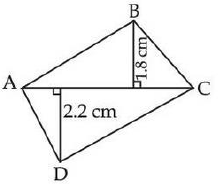
From the figure, find the area of quadrilateral ABCD when AC = 4 cm.
Answer & explanation
Correct answer: option 3
The correct answer is Option (3) → 8 cm2
The diagonal AC splits the quadrilateral into two triangles, ABC and ADC, with AC as their common base. The perpendiculars drawn to AC from B (1.8 cm) and from D (2.2 cm) are their heights.
Area of triangle ABC \(=\frac{1}{2}\times4\times1.8=3.6\) cm2
Area of triangle ADC \(=\frac{1}{2}\times4\times2.2=4.4\) cm2
Area of ABCD \(=3.6+4.4=8\) cm2
Shortcut: With a diagonal and the perpendiculars to it from the other two corners, the area is half the diagonal times the sum of the perpendiculars.
\(\frac{1}{2}\times4\times(1.8+2.2)=2\times4=8\) cm2