
The complex [Co(NH3)6]3+ is
Answer & explanation
Correct answer: option 4
The correct answer is Option (4) → d2sp3 hybridised, and diamagnetic in nature.
In valence bond theory, an octahedral complex uses six hybrid orbitals of the metal ion to accept six electron pairs from the ligands. There are two ways to make them:
d2sp3 – two inner 3d orbitals + 4s + three 4p. Two 3d orbitals must be empty, so the d electrons pair up in the other three. This gives an inner orbital (low spin) complex.
sp3d2 – 4s + three 4p + two outer 4d orbitals. The 3d electrons stay unpaired as in the free ion. This gives an outer orbital (high spin) complex.
Cobalt (Z = 27) is [Ar]3d74s2. In [Co(NH3)6]3+ the six NH3 ligands are neutral, so the oxidation state x of Co is:
\( \displaystyle x+6(0)=+3\ \Rightarrow\ x=+3 \)
Losing the two 4s electrons and one 3d electron gives \( \ce{Co^3+} \): 3d6, with four unpaired electrons in the free ion. With NH3, the six 3d electrons pair up in three 3d orbitals, leaving two 3d orbitals empty for d2sp3 hybridisation. The complex is octahedral and has no unpaired electron, so it is diamagnetic.
Why the other options are incorrect
Option (1) sp3d2 hybridised, and paramagnetic in nature. — Incorrect. This describes the outer orbital complex [CoF6]3−, where the 3d6 electrons stay unpaired (four unpaired electrons) and the 4d orbitals are used. It does not describe the ammine complex, which is diamagnetic.
Option (2) sp3d2 hybridised, and diamagnetic in nature. — Incorrect. The two parts do not fit together for Co3+. In sp3d2 the 3d electrons are not paired, so a 3d6 ion would keep four unpaired electrons and be paramagnetic.
Option (3) d2sp3 hybridised, and paramagnetic in nature. — Incorrect. For a d6 ion, d2sp3 hybridisation needs all six d electrons paired in three orbitals, so none is left unpaired and the complex cannot be paramagnetic.
NCERT (2026-27 edition):
Valence Bond Theory – “In the diamagnetic octahedral complex, [Co(NH3)6]3+, the cobalt ion is in +3 oxidation state and has the electronic configuration 3d6. The hybridisation scheme is as shown in diagram.
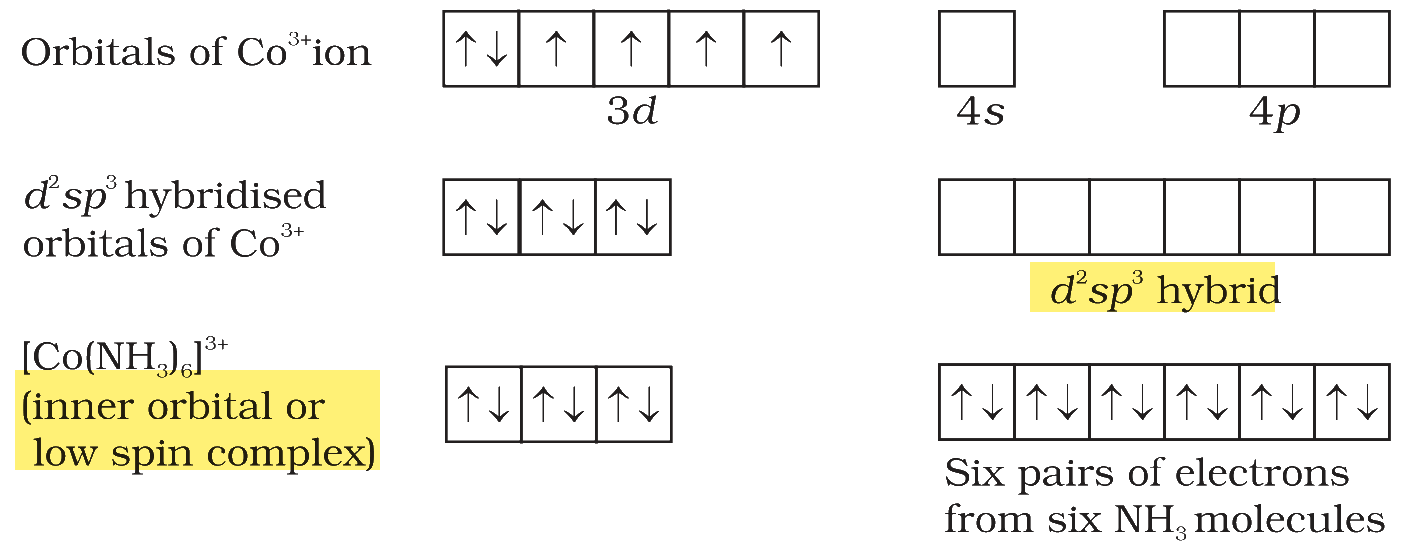
Six pairs of electrons, one from each NH3 molecule, occupy the six hybrid orbitals. Thus, the complex has octahedral geometry and is diamagnetic because of the absence of unpaired electron. In the formation of this complex, since the inner d orbital (3d) is used in hybridisation, the complex, [Co(NH3)6]3+ is called an inner orbital or low spin or spin paired complex. The paramagnetic octahedral complex, [CoF6]3– uses outer orbital (4d ) in hybridisation (sp3d2). It is thus called outer orbital or high spin or spin free complex.”